The Economics of Sport
  • Sports Economics
  • About
  • Workshop
  • Selected Publications
  • Book Reviews
  • A Primer on Gaelic Games
  • Upcoming Events
  • Media
  • Education
  • Resources & Links

Amazon Prime and the Premier League

15/11/2019

 
By Robbie Butler

For UK and Ireland subscribers of live Premier League games, we are now under a month away from the arrival of a third supplier in the market – Amazon, via their streaming service Amazon Prime. For those unfamiliar with the history of the broadcasting of top flight football in England, the game has moved from provision by free-to-air services in the 1980s, to subscription television since 1992.

Our paper in the Journal of Sports Economics this year explains why the BSkyB monopoly from 1992 to 2007 was brought to an end by the European Commission. However, since then Sky Sports has competed with only one other provider at a given time. While the competition has changed from Setanta Sports, to ESPN, to BT Sports, the ending of the 12-year-old duopoly by Amazon next month is uncharted territory.

While the European Commission’s intervention in the market, to break up the monopoly, sought to protect consumers, it has only resulted in making it worse. A 3rd provider may be another step in the wrong direct.

From December 3rd Amazon Prime will show 2 of the 20 live games it has rights to screen during the 2019/20 season. However, unlike Sky Sports and BT Sports it won’t be possible to watch all live games as some occur simultaneously.  Crystal Palace v Bournemouth will kick-off at 7.30pm on December 3rd while Burnley v Manchester City will start at 8:15pm. This means a clash between part of the second half of the 7.30pm game and first half of the 8.15pm game.

Things get worse the following night. On Wednesday the 4th, five games will kick-off together at 7.30pm (Chelsea v Aston Villa, Leicester v Watford, Manchester United v Tottenham, Southampton v Norwich Wolves v West Ham) while the Merseyside Derby between Liverpool and Everton will start at 8.15pm.
​
Given the kick-off times in the second round of games Amazon Prime will show on the 26th of December, it will only be possible to watch 8 of the 20 games in their entirety. All 128 games on Sky Sports, and the 52 games on BT Sports can be watched as they do not clash with one another. The 3rd provider has a different set of dynamics and one has to wonder how customers will react.
Ireland And The "Inevitable" Draw?

17/10/2019

 
By Robbie Butler

During the summer of 2015, I wrote about the Republic of Ireland football team and the number of drawn games the team was involved in. 4 years ago, the Boys In Green led the way for the number of draws during UEFA qualifying for major championships (World Cup and Euros). With Ireland's fate now to be decided next month in the Aviva, I thought it timely to revisit this. The reality is that Ireland have become even more of an outlier.

Let's look closer.

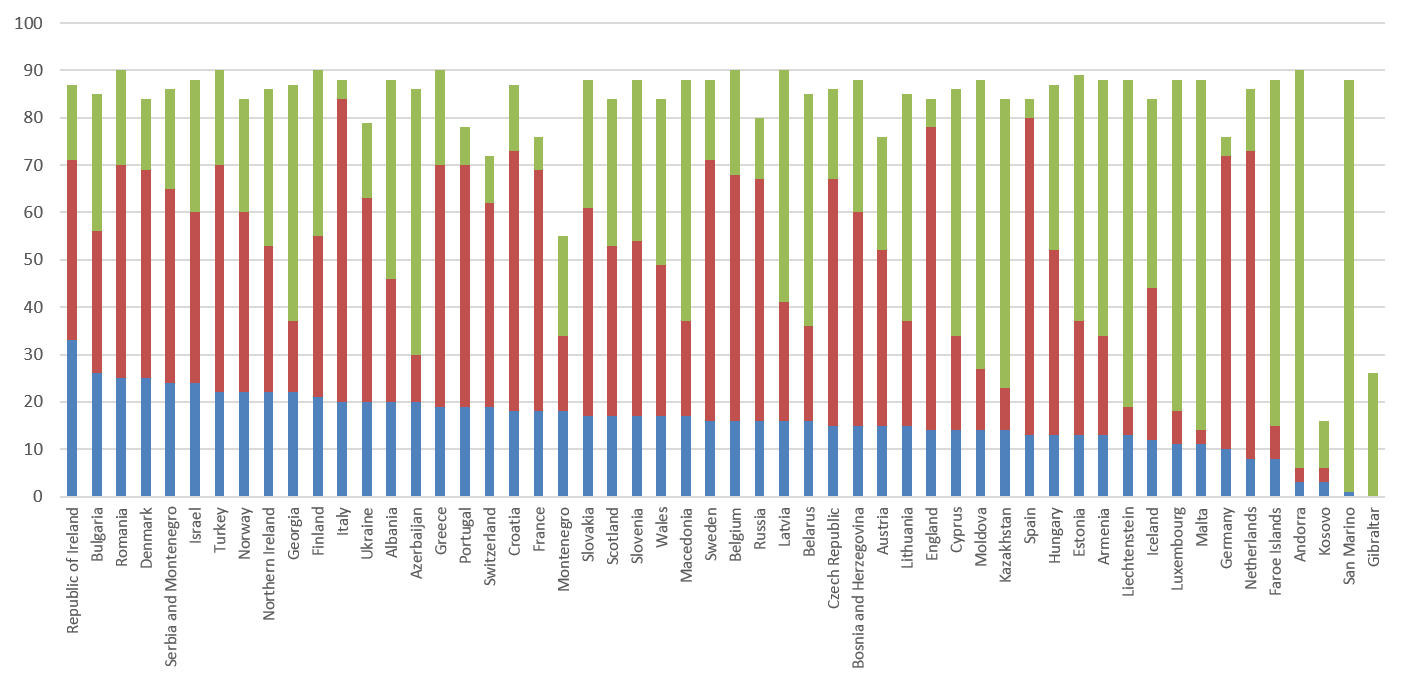
The graphic below presented data on draw (blue)/win(red) /loss(green) outcomes for all UEFA nations between 2002 and 2020 qualifying, as of today. Yet again, the Republic of Ireland appear on the far left.
Picture
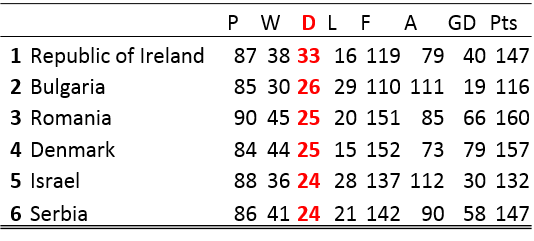
The Republic of Ireland have now drawn more group qualifying games, and considerably more at that, than any UEFA country since World Cup 2002 qualification. In total, this amounts to 33 games. That is 33 out of 87, nearly 40%. The draw "leaderboard" is presented to the right.

At the same time the team have won 38 games. The win rate ranks Ireland 23rd out of all UEFA members, and with 24 countries at the Euro's since 2016 (including the hosts) it would seem obvious why our qualification always comes down to the wire.
Picture
UEFA Members - Top Drawing Teams 2002-2020. Serbia competed as Serbia and Montenegro in 2004 and 2006.
W​ith a loss rate of just 16 games, only 13 UEFA members have a better record than the Boys in Green over nearly 20 years. Belgium, Sweden, Czech Republic, Turkey and Greece have all lost more times.

However, despite losing more games, Turkey have played at the same number of major finals (3), Belgium 4 (and with Euro 2020 this will be 5), Greece 5 (including winning Euro 2004!), Czech Republic 6 and Sweden 7! 

As I said in 2015, we simply draw too many games. This campaign alone has witnessed three (Denmark, Switzerland and Georgia). As we now know, a draw at home to Denmark next month won't be enough. Let's hope we can avoid, what seems to be, the inevitability of this - a next month a draw is the same as a loss. 

Franchise Expansion and the MLS

17/9/2019

 
By Robbie Butler

Next year, Club Internacional de Fútbol Miami, more commonly known as Inter Miami will join Major League Soccer (MLS) and become the 26th active franchise in North America. The arrival of the Florida based team is well flagged, even within European circles, as it is linked to the 2007 contract that David Beckham signed when agreeing to play for LA Galaxy. MLS is different to European leagues in regards to many aspects, and here is yet another example.

The goal of most sports franchise owners in North America is to maximise profit. While this is advantageous in European leagues, clubs are more often regarded as 'win maximers'. The reason North American sports can focus on profit (as well as winning) is helped by the behaviour of franchise owners, who often manage or directly influence the leagues they compete it. Acting as a monopsony, owners behave in a manner that reduces the power of other stakeholders. e.g. players.

One way this can occurs is through league expansion. Creating a new franchise is no easy task. As North American leagues generally don't facilitate promotion and relegation, successful entry to a league means 'permanent' status. Such entry is then only permitted with the payment of a sizable fee, and full agreement of the current league members.

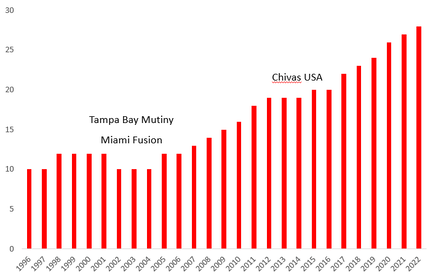
For evidence of league expansions one need only look at US soccer. By 2022, the MLS should reach 28 franchises. Inter Miami will be joined by Nashville SC next year, Austin FC (2021) and St. Louis (2022). 28 is a good number and a far cry from the original 10-team MLS that started in 1996. However, as the image below shows, it hasn't been all plain sailing.
Picture
​Since the league was inaugurated in 1996, three franchises have gone out of business. Worryingly for Backham and Co., two of these were based in Florida (Tampa Bay and Miami).

The most recent bankruptcy was Chivas USA, which left the MLS in 2014. Sale of the franchise to a group of businessmen, including Cardiff owner Vincent Tan, resulted in the emergence of Los Angeles FC in 2017.

This brings the number of major franchises in LA to 10! (NFL - Rams and Chargers; MLB Dodgers and Angels; NBA - Lakers and Clippers; NHL -Kings and Ducks; MLS - Galaxy). Only New York (11) has more.

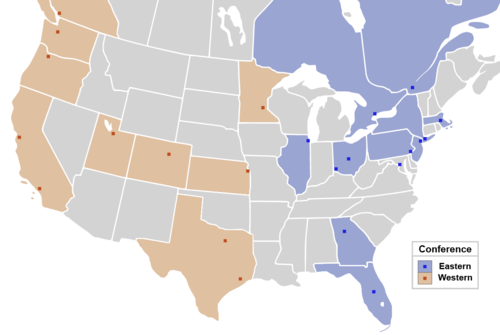
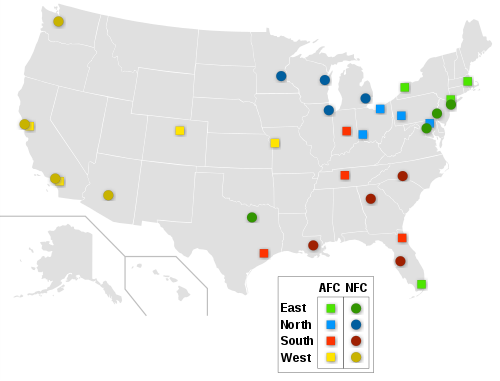
One can only guess as to how much more the MLS will expand, but it would seem that 30 to 32 franchises may be the target. This would then put the sport in line with MLB, NBA or NFL. In fact, the current franchise map is starting to look very like the other major sports.

Picture
Picture
On the left, the current locations of the MLS sit reasonably well with the locations of NFL franchises. The return of a second MLS franchise to Florida would appear to make sense. As does the arrival of the first franchises in Missouri and Tennesse. 

The decision to create a 3rd franchise in Texas is a little less obvious but a first for the MLS. No other state will have 3 MLS teams. In fact, the only example of  major US sport with the three NHL franchises in the same city is that of New York - New York Rangers, New York Islanders and Buffalo Sabres.

BREXIT and Football Management

22/8/2019

 
By Robbie Butler

Recently, former Premier League manager Ian Holloway made some bizarre comments on Sky Sports show The Debate regarding Brexit:

"I hope we get out, Brexit, because that's what we all voted for. And sort that out because you cannot have someone telling us how to do our own game. FIFA and UEFA have brought these rules in, they told us we've got to use VAR that I’ve got no problem with, but that handball rule that they’ve made up, I don’t want to listen to them. That’s nonsensical," 

He later went onto say, "Brexit is nothing to do with the football rules, is it? I’m not that stupid, so I suggest people wash their ears out and listen. As an English person, I’m sick and fed up of being told what we’ve got to do. Our country is fantastic. If you let us make our own rules up, do what we want to do, we’ll be in control of it a lot better. I don’t like UEFA and I don’t like FIFA telling us what we should do in our English football game. We should take control of our own game, then that wouldn’t have happened. Let’s get out and stop the EU dictating to us what we can do. I feel exactly the same with UEFA and FIFA over our football."

Let's take a closer look at how inaccurate these comments are. 

The body with responsibility for developing and preserving the rules of the game are the International Football Association Board (IFAB), founded by the four British football associations. These originally consisted of England, Wales, Scotland and Ireland. However, following the formaiton of the Irish Free State  in 1921, IFAB  became the football associations' of England, Wales, Scotland and Northern Ireland.

Each of these has one vote on the IFBA Board today. FIFA is now also a member and holds 4 votes, or 50% of the voting power. However, the rule changes that Holloway is opposed to needed 6 votes to pass, so at least 2 UK members were required to tell 'England what to do with their football game'. 

So instead of what Holloway is suggesting that "...you cannot have someone telling us how to do our own game. FIFA and UEFA have brought these rules in", they have not. 

He continues "If you let us make our own rules up, do what we want to do, we’ll be in control of it a lot better". But that is pretty much what you have. There are 211 FIFA affiliated associations. Only 4 are members of IFAB. The same 4 countries that voted in the Brexit Referendum. 

Finally, his comments "Let’s get out and stop the EU dictating to us what we can do. I feel exactly the same with UEFA and FIFA over our football", are inaccuarte becasue neither can dictate. In fact, IFAB could never pass another rule change again if just Britain (England, Scotland and Wales) decided to vote against every change. So 3 countries could block 208 others and FIFA. Where is the loss of control?

Holloway is not the only manager to comment on Brexit. Last year Cardiff City's Neil Warnock said:

"I don't know why politicians don't do what the country wanted, if I'm honest. They had a referendum and now we see different politicians and everyone else trying to put their foot in it. Why did we have a referendum in the first place? I can't wait to get out of it, if I'm honest. I think we'll be far better out of the thing - in every aspect, football-wise as well, absolutely. To hell with the rest of the world." The club were quick to point out that "These comments do not reflect the political position of Cardiff City Football Club, nor its board of directors."

While Warnock and Holloway appear to be stanuch Brexiters, Liverpool's Jurgen Klopp takes a very different view. Earlier this year the German said:

"What do you want? A not perfect situation alone or a not perfect situation as a strong partner in a very strong unit. That's only common sense. That's only common sense because history taught us that if you are alone you are weaker than the unit. I'm 51 years old so I have never experienced a war. We are really blessed in our generation, but the past showed us that as long as strong partners are together, Europe is a much safer place...Yes, we have problems but let's solve them...Just calm down and stick together and stop listening to people with no knowledge, from the right side because that's never the solution...I still hope that somebody will use common sense at the end and doesn't use the situation to try and improve only their own position".

While just 51, Klopp must surely have been only too aware of the devastating consequences of World War II and the partition of Germany. As the past 3 years have demonstrated, the UK appears to looks upon the years 1939 to 1945 as to how 'going it alone' in Europe is the key to success. 

I also wonder to what extent the presence of non-British managers in top English clubs, for about the past 20 years, is influencing the views of the likes of Warnock and Holloway. This generation of British managers were the first ever not to be given the chance to manage many of the top English clubs. That must be the EU's fault too. 

Away Fan Ticket Allocation In The Premier League

21/8/2019

 
By Robbie Butler
​
Home advantage in sport has received considerable attention in both the economics and psychology literature. Playing at home is advantageous for teams as it is a familiar environment for players, requires shorter travel and often contains a partisan groups of supporters.

Previously, Nevill, Balmer & Williams (2002) have found that crowd noise effects refereeing decisions, with home teams awarded significantly more free-kick than away teams. Garicano, Palacios-Huerta and Prendergast (2005) report referees often favour home teams, in order to satisfy the crowds in the stadium, by shortening close games where the home team is ahead, and lengthening close games where the home team is behind. In fact, stadiums where supporters are located further from the field of play, for example due to the presence of a running track, are more likely to witness more impartial refereeing decisions. Spectators simply can't influence referees in the same way.

The English Premier League (EPL) is a nice place to consider this. One of the many great things about the EPL is the substantial presence of away fans at games. If one watches other European leagues, particularly La Liga, away fans are barely noticeable. For example, when Barcelona travel to Madrid to play great rivals Real, a scattering of fans can be seen in the upper tier of the Bernabeu when they score. The same is true of Real fans at the Camp Nou.

Away fans in the EPL normally get access to 3,000 tickets per game, or 10% of stadium capacity if greater than 30,000 seats. In 2017/18 the EPL introduced rule changes to further encourage away fan attendance. This was on a back of a three-year cap on away fan ticket prices at £30. According to the EPL, the 2017 changes included a commitment that would see "away supporters...seated together at all stadiums and at least one block of away fan seats...made available pitch side". This is important as it moved away fans closer to the field on play.

Four clubs at the time were earmarked for change: Sunderland, Newcastle, Manchester United and Tottenham. I often thought it a masterstroke from Manchester United to place fans in the upper tier of the stadium by the corner flag. The Old Trafford club have subsequently had to change, as have Sunderland. Tottenham moved stadium but have since now allocated away fans lower tier seats in the new Tottenham Hotspur Stadium. Newcastle remain the only club to place fans in the 'gods'. The Tyneside clubs are permitted to do so on health and safety grounds, meaning away fans are a long way from their heroes at St. James Park.
Picture
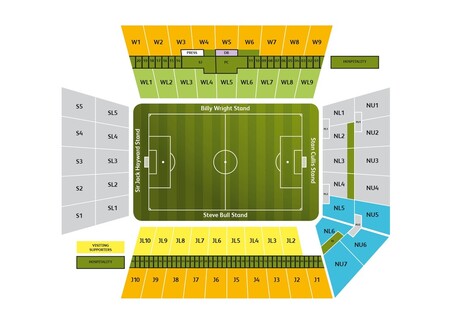
This brings us to Wolves. For some years the Midlands clubs have seated away fans in the lower tier of the Steve Bull Stand. The stadium plan is presented to the right. The section for away supporters is marked in yellow.

Aside from having an excellent view of the game - lower tier side-line tickets are usually the most sought after - fans are grouped together for the entirety of the side-line. This means a group of supporters will at all times be directly adjacent to the assistant referee. Such placement cannot be in the interest of the home team. ​As assistant referees normally run on the half of the pitch closest to each left-back, clubs often place away fans near the right-back position so as to maximise the distance between them and each assistant referee.

From observation, I believe Aston Villa, Norwich and Crystal Place place away fans beside the left-back position. Wolves are even more accommodating to away spectators. Whether or not this matters is open to debate but most other clubs in the Premier League seem to take a different approach, and none offer an entire lower tier of a side-line stand to the away support.

Eurocentrism & The Europa League

17/6/2019

 
By Robbie Butler

The Wealth and Poverty of Nations is a masterful exploration of political economy by the late Harvard professor David Landes. Very early into this 650 page text the author raises the issue of Eurocentrism - a worldview that is inherently biased towards Western civilization, or western Europe (depending on ones' definition). 

At a recent event at the University of Oxford, UEFA President Aleksander Ceferin appeared to suggest that such Eurocentrism is alive and well in European football. The former Slovenian lawyer said the following about the recent Europa League Final stage in Baku, Azerbaijan:

"We decided a year and a half ago that we play in Baku, which has a modern stadium of 70,000. I think there is only one stadium in England that is bigger....If somebody asks me why we played in Baku, I would say: 'People live there. Homo sapiens live there...They had to watch the game at 11pm because of the time difference but nobody complained...If we have two Azerbaijani teams playing in London nobody would complain. They would come and play without any problems...We have to develop football everywhere not England, Germany only...[the] Europa League and everything else should be shared with the others who love football."

Ceferin's comment was largely motivated by the negativity surrounding the Final last month between Chelsea and Arsenal. Much of the commentary of the Final focused on the empty seats at the stadium and lack of atmosphere. Many questioned why fans had to travel so far to see their teams complete. A vivid example of Eurocentrism?

Although the 'big 5' have some of the largest populations in Europe, UEFA represents 55 full member associations . The association’s strategic plan from 2019-2024 has four pillars one of which aims to “Promote and develop football infrastructure across Europe”. Spreading the game is a mission that has been at the core of UEFA, and FIFA for that matter, for many years. This is why cities such as Baku get the chance to host major finals. 

It was impossible to predict who would play in Baku, and the distance fans had to travel was probably accentuated by the fact that Chelsea and Arsenal are under 10 miles apart. Despite what people may now believe, this was not a poorly attended final. In fact, it is the 3rd best attended Europa League Final to date.

Countries on the periphery of Europe are just as entitled to hosts these games as the England, Germany or Spain. In fact, I recall not so long ago a country on the edge of Europe hosting the Europa League final. I was there when two Portugesse teams just 55 km apart, were forced to travel a round trip in excess of 2,700 km. The location? Dublin. I don't remember the Portuguese having any problems. 

45,391 people showed up in the Aviva that night. There were 5,979 more in the Baku Olympic Stadium. 

Despite a record win by the USA, goals are harder to get at the Women's World Cup

10/6/2019

0 Comments

 
by Declan Jordan
Picture
The FIFA Women's World Cup in France continues to throw up great games and surprises. The women's game is in the spotlight and, while the football has been great, there are frustrations at FIFA's organisation and commitment to the game, pay inequality, and sexism.

It is perhaps unavoidable that the competition and women's football generally is compared to the men's equivalent. It is not difficult to find patronising commentary on television and in print media whenever women's football is covered. There is almost surprise, particularly in the Irish and UK coverage with which I am most familiar, that professional athletes are technically skillful, competitive, and committed. (There are similarities in the treatment of female football analysts, referred to by Alex Scott here. That it is surprising that someone who has played 140 times for her country should be insightful about the game says a lot about our attitudes to women in football).

Perhaps these attitudes are based on an outdated notion of the women's game, though there are certainly socialised stereotypes at play as well. In a recent article in the Irish Examiner, Larry Ryan referred to a comment by England striker Toni Duggan that she was somewhat heartened to see the anger from opposition fans when she celebrated a goal she scored for Barcelona. For her it showed that the game mattered and the players were being taken seriously. The article though warns that the women's game should try to avoid going down the road of the men's game and should instead try to hold on to the values of inclusion, loyalty, and community.

This doesn't mean of course that the women's game will not get more competitive, skillful, and demanding.

The negative stereotypes will take time to break down of course, but it is interesting to review the data on previous World Cup Finals, both women's and men's, to shed some light on the game's development.The USA's 13-0 demolition of Thailand has led to some suggestions that the World Cup is losing credibility and the increase in teams from 16 to 24 will damage the tournament with more one-sided games.

The data doesn't back this up however.

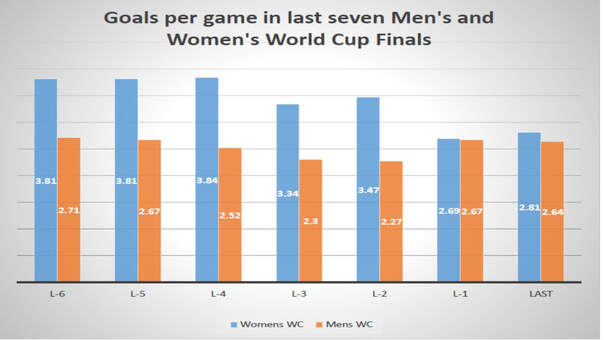
The graph below shows the goals per game at each of the last seven World Cup Finals tournaments (the last men's tournament was 2018 in Russia and the last Women's tournament was in 2015 in Canada). For information, in the first round of group matches in the current tournament (12 in all) to Tuesday June 11, there have been 3.17 goals per game. Excluding the USA-Thailand game the ratio is 2.27 goals per game).

It is striking how the ratio of goals per game has declined over the seven tournaments. From having just over a goal more per game, the women's tournament has now reached a comparable level with the men's. Whether this is a positive or negative development is unclear, though even as the number of countries in the finals of the Women's World Cup has increased goals have become more difficult to come by.


Picture


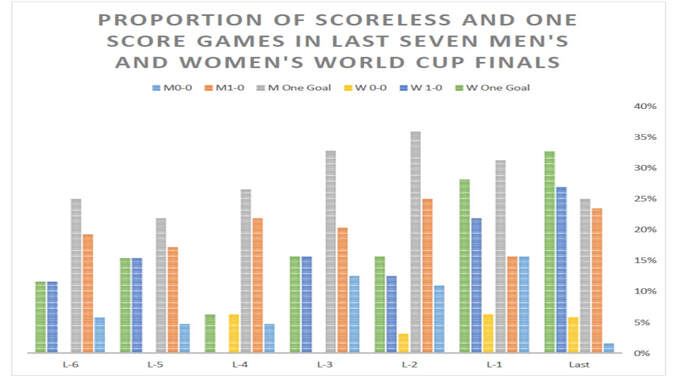
Similarly with the number of low-scoring games, there has been a narrowing in the differences between the tournaments over time. The Women's World Cup Finals did not see a scoreless match until the final day of the third World Cup (in 1999) when both the third place play-off and the final ended nil all. Up to the last World Cup finals there have been nine scoreless matches. There has been one more in current tournament when Argentina parked the bus against the favoured Japanese. In comparison over the last seven men's tournaments there has been an increase in scoreless matches from close to 5% of matches to 15% in 2014. In 2018 there was only one scoreless match.

It is interesting though to include the number of games that have ended 1-0. The green bar in the graph below shows the proportion of matches that have had one goal or less (within 90 minutes). The women's World Cup has gone from about 12% of matches in the first tournament in 1991 (and only 6% in 1999) to a third of matches in 2015. (A third of the 12 games in the current tournament have had one goal or less). 

​The grey bar shows the corresponding data for the men's tournaments. Rising from 1994 to 2010 before falling in 2014 and 2018, the level has been between about a quarter and a third. The women's rate has exceeded the men's in the most recent tournament. 

It may be that the fewer number of participants in the women's finals means the best teams are playing and the matches are closer. The number of teams taking part increased however in 2015 from 16 to 24. Adding the extra teams has not diminished the closeness of the games (measured by the proportion of low scoring games). It may instead point to an increase in standards - or at least a decrease in the variability of standards - at the elite level and the women's game converging with the men's game, whether for good or ill.

The data may also point to greater levels of organisation in coaching and associated resources from national bodies for the women's national teams, and further posts may explore that idea.
Picture
0 Comments

VAR In Action

10/4/2019

 
By Robbie Butler,

One year ago next week I wrote this. The piece tries to explain where the Video Assistant Referee (VAR) can be usefully deployed in football, and where it cannot.

It's fair to say, the response to VAR has been mixed. It is very much debatable where the benefits of the system outweigh the (often) unintended consequences of using the technology. My original piece explains that in certain instances in football, video technology can help referees make better decisions. However, in some cases it is unhelpful. The crux of the issue is whether the rule of law is being interpreted objectively or subjectively.

Tottenham vs Manchester City last night provides two perfect examples.

VAR 1: Danny Rose's "handball".
IFAB Laws of the Game state that handling the ball involves "a deliberate act of a player making contact with the ball with the hand or arm. The following must be considered: • the movement of the hand towards the ball (not the ball towards the hand) • the distance between the opponent and the ball (unexpected ball) • the position of the hand does not necessarily mean that there is an offence." Deciding whether or not Danny Rose's action last night was deliberate is purely subjective. Some may argue he made himself bigger. Others may suggest his hands were in a natural position for a defender making a last ditch tackle and that there was a short distance between Rose and Sterling. I don't believe it was a penalty, and more tellingly neither did the Man City players or staff. Not one opponent looked for a penalty.

VAR 2: Heung Son-Min keeps the ball in play.
The question put to the referee is simply did all of the ball cross all of the end-line. This is not subjective. The ball either did or didn't. Here VAR worked perfectly, just like it does in tennis and rugby.

VAR is supposed to eliminate controversy, not cause it. It needs to be dropped in the case of VAR 1 and kept in the case of VAR 2.

​Referee's should decide if the ball was deliberately handled. That's what they are there for after all!

The Road to Euro 2020

22/3/2019

 
By Robbie Butler

Qualifying for Euro 2020 started last night and continues over the coming days. Scotland got off to the worst possible start losing by three goals to nil in Kazakhstan. The positive news for the Scots is that qualifying for the Euro's is not as difficult as it once was. The competition structure has changed quite dramatically since the early years of the competition, and next year 24 of the 55 UEFA members will appear at the finals. That's not far off one in two nations.

If one discounts the seven lowest ranked teams in UEFA (Gibraltar, Faroe Islands, Latvia, Liechenstein, Andorra, Malta and San Marino), every second country entering the competition will qualify.

Compare this to Ireland's first appearance at a Final's - Euro '88. While there were just 32 UEFA members, only 8 appreaded in Germany at the Finals. Just seven qualified as the hosts were guaranteed a place at the party. This means roughly 4 out of 5 countries watched on as Ireland famously toured Stuttgart, Hanover and Gelsenkirchen. This probably remains the countries biggest achievement when it comes to tournament qualification.
Picture
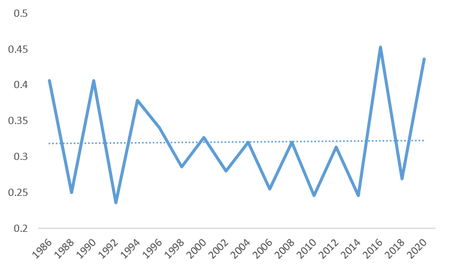
The figure illustrates the fraction of UEFA teams that could qualify for World Cups and European Championships from 1986 to 2020. ​

The trend line is almost flat (slightly rising). The interesting quirk in the data, if one looks closely at the years, is the flip in difficulty between competitions. In 1988 and 1992 the Euros were hard to get to, the World Cup much easier. Today the Euros have expanded meaning the chances of qualifying are much higher. World Cup qualification from Europe is much tougher and is likely to stay at way even after the competition expands.

So disappointed Scotland fans waking up this morning should take comfort. Yesterday's loss might not be as damaging as in the past. The Euro Finals are not what they once were. 

Efficiency Wages in Premier League

1/3/2019

 
By Stephen Brosnan

This post explores the relationship between Premier League club’s spending on both salaries and transfers and the number of points won during the current Premier League season.
Picture
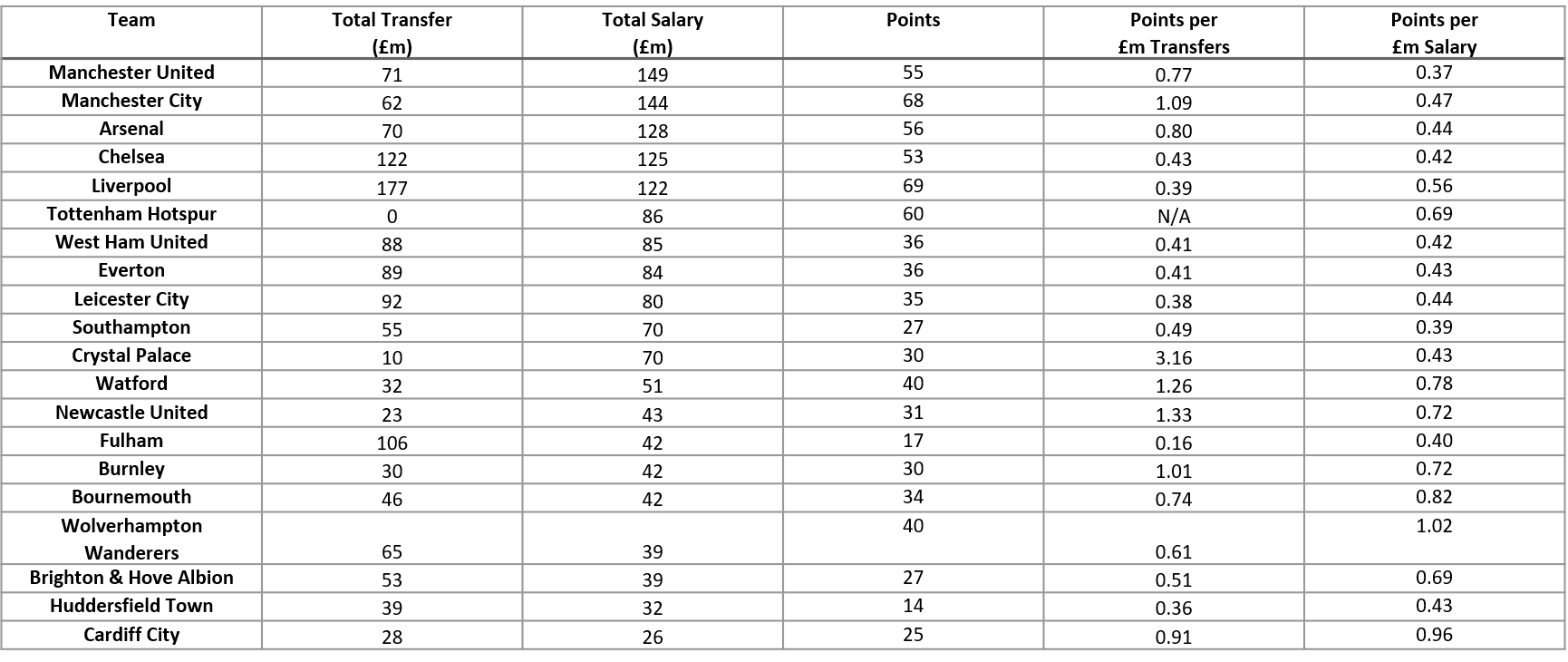
Since 2015, Man United have had the highest annual player salaries amongst Premier League clubs. This year total salary paid out to players at Old Trafford topped £148 million. This includes the Premier Leagues top earner Alexis Sanchez, often founding warming up the United bench while picking up a hefty £315,000 p/w.

Cardiff City have the lowest wage bill in the Premier League this season. The newly promoted Bluebirds remained conservative in their approach to top flight survival. Cardiff’s summer transfer spending (£29m) was a fraction of the other promoted team’s spending. Fulham spent a hefty £105m during the summer while Wolves brought in £65m worth of talent. Only Tottenham (£0), Crystal Palace (£9.5m) and Newcastle (£23.2m) spent less than Cardiff last summer.

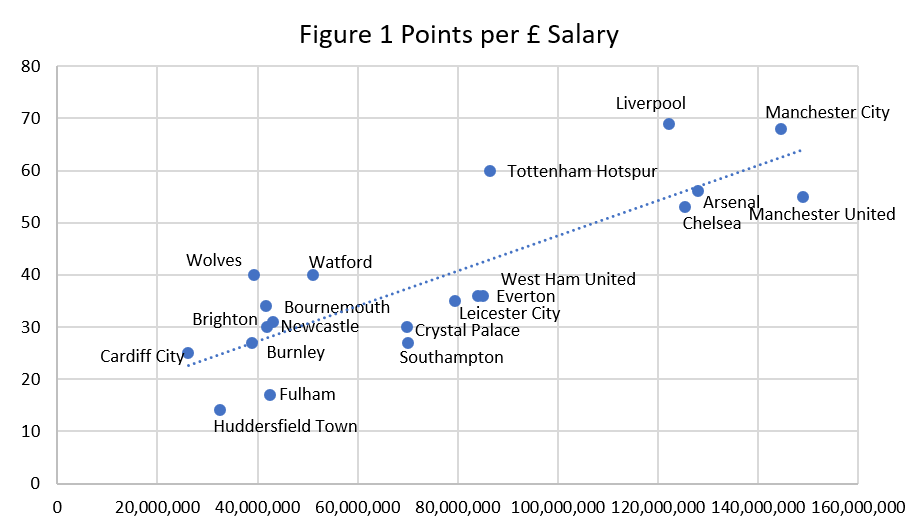
The question remains who have been the most efficient club in terms of spending on annual salaries? The figure below shows Premier League team’s total points and spending on salaries. 
Picture
All the teams above the line can be considered ‘efficient’. Wolves rank first for points per £m spent on player’s salaries. So far this season, Wolves have accumulated 40 points in the Premier League having spent £39 million on player’s salaries. This represents 1.02 points per million pounds spent on player’s salaries. Other ‘efficient’ teams include Manchester City, Liverpool, Tottenham, Watford and Brighton.

Manchester United are the most inefficient team in terms of points per £ spent on player’s salaries. The team has only won 0.37 points per million pounds spent on player’s salaries. This may be surprising given their recent form under Ole Gunnar Solskjaer but also may go a long way in explaining why they replaced former manager Jose Mourinho.
​
The other ‘inefficient’ teams include relegation candidates Huddersfield and Fulham along with Southampton, Crystal Palace, Everton, Leicester and West Ham. Over half of these teams have changed manager throughout the season which suggests that the team’s inefficiencies were no secret. Meanwhile, none of the managers of the ten ‘efficient’ teams have lost their jobs. 
<<Previous
Forward>>

    Archives

    October 2026
    September 2026
    August 2026
    July 2026
    June 2026
    May 2026
    April 2026
    March 2026
    February 2026
    January 2026
    December 2025
    November 2025
    October 2025
    September 2025
    August 2025
    July 2025
    June 2025
    May 2025
    April 2025
    March 2025
    February 2025
    January 2025
    December 2024
    November 2024
    October 2024
    September 2024
    August 2024
    July 2024
    June 2024
    May 2024
    April 2024
    March 2024
    February 2024
    January 2024
    December 2023
    November 2023
    October 2023
    September 2023
    August 2023
    July 2023
    June 2023
    May 2023
    April 2023
    March 2023
    February 2023
    January 2023
    December 2022
    November 2022
    October 2022
    September 2022
    August 2022
    July 2022
    June 2022
    May 2022
    April 2022
    March 2022
    February 2022
    January 2022
    December 2021
    November 2021
    October 2021
    September 2021
    August 2021
    July 2021
    June 2021
    May 2021
    April 2021
    March 2021
    February 2021
    January 2021
    December 2020
    November 2020
    October 2020
    September 2020
    August 2020
    July 2020
    June 2020
    May 2020
    April 2020
    March 2020
    February 2020
    January 2020
    December 2019
    November 2019
    October 2019
    September 2019
    August 2019
    June 2019
    May 2019
    April 2019
    March 2019
    February 2019
    January 2019
    December 2018
    November 2018
    October 2018
    September 2018
    August 2018
    July 2018
    June 2018
    May 2018
    April 2018
    March 2018
    February 2018
    January 2018
    December 2017
    November 2017
    October 2017
    September 2017
    August 2017
    July 2017
    June 2017
    May 2017
    April 2017
    March 2017
    February 2017
    January 2017
    December 2016
    November 2016
    October 2016
    September 2016
    August 2016
    July 2016
    June 2016
    May 2016
    April 2016
    March 2016
    February 2016
    January 2016
    December 2015
    November 2015
    October 2015
    September 2015
    August 2015
    July 2015
    June 2015
    May 2015
    April 2015
    March 2015
    February 2015
    January 2015
    December 2014
    November 2014
    October 2014
    September 2014
    August 2014
    July 2014
    June 2014
    May 2014
    April 2014
    March 2014
    February 2014
    January 2014
    December 2013
    November 2013
    October 2013
    September 2013
    August 2013
    July 2013

    About

    This website was founded in July 2013.

    RSS Feed

    Categories

    All
    American Football
    Athletics
    Baseball
    Basketball
    Behavioural Economics
    Boxing
    Broadcasting
    Competitive Balance
    Cricket
    Cycling
    Darts
    David Butler
    Declan Jordan
    Drugs
    Ed Valentine
    Epl
    Esports
    Expenditure
    F1
    Fifa World Cup
    Finances
    Funding
    Gaa
    Gaelic Games
    Gambling
    Game Theory
    Gary Burns
    Geography
    Golf
    Greyhound Racing
    Guest Posts
    Horse Racing
    Impact Studies
    John Considine
    John Eakins
    League Of Ireland
    Location
    Media
    Mls
    Mma
    Olympics
    Participation
    Paul O'Sullivan
    Premier League
    Regulation
    Research
    Robbie Butler
    Rugby
    Simpsonomics
    Snooker
    Soccer
    Spatial Analysis
    Sporting Bodies
    Stephen Brosnan
    Swimming
    Taxation
    Teaching
    Technology
    Tennis
    Transfers
    Uefa
    Ufc
    World Cup
    Wwe

Powered by Create your own unique website with customizable templates.