The Economics of Sport
  • Sports Economics
  • About
  • Workshop
  • Selected Publications
  • Book Reviews
  • A Primer on Gaelic Games
  • Upcoming Events
  • Media
  • Education
  • Resources & Links

Why hasn't Triathlon had a Major Problem with Doping?

23/9/2013

 
by Paul O'Sullivan
The issue of doping in sports has been in the public eye in recent years, with cycling, athletics and baseball, among others, having major doping scandals. One sport that has avoided tainting by doping is the increasingly popular triathlon. On the face of it, this may be surprising given the physical requirements of the sport, where athletes swim, cycle and run for relatively long distances and time periods, and the relatively low technical ability required, but perhaps not so for other reasons.
Picture
By assuming that an athlete’s natural state is ‘clean’, economists usually frame the decision to dope in terms of a cost-benefit analysis, with an athlete choosing to dope if the expected benefit of doping outweighs its expected cost. The benefits can include higher prize money, sponsorship and appearance fees, the emotional joy from winning, greater  fame, etc. On the other hand, the costs can include the monetary and long-term health costs of doping, any fines and suspensions as a result of detection, the feeling of guilt and reputational damage from knowing that one is a cheat, etc.  Doping has the characteristics of a ‘Prisoner’s Dilemma’ as each athlete may have an incentive to dope if no-one else does, but all are worse off if everyone dopes as win probabilities may be unchanged but all must incur doping costs. 
 
Up to relatively recently, triathlon was a sport with little prize money and exposure. The last number of years, however, has seen a major increase in both participation and general interest in the sport. The ITU World Triathlon Series increased its total prize money for 2013 by over 9% to over $2.25 million (see here), while some Ironman races offer first prizes of $75,000 with the Ironman World Champion winning $650,000 (see here). TV coverage has also increased with Sky showing regular highlights of the ITU Series and Setanta covering the Ironman series. All else equal, one would expect the greater prize money and TV exposure to increase the incentive to dope.

Anti-doping regulation in triathlon is, in theory, on a par with most sports as the two main triathlon bodies, the  International Triathlon Union (ITU) and the World Triathlon Corporation (WTC), have incorporated the World Anti-Doping Agency (WADA) ‘Code’(see here) and have also introduced the Athlete Biological Passport (ABP) scheme(see here). While a small number of triathletes have been found guilty of doping offences in the last number of years, there are still gaps in the testing mechanism (see here for a more in-depth discussion).

One of the major reasons for doping in cycling was that the cyclists and their medical teams were so far ahead of the testers that the likelihood of detection was effectively zero (see Tyler Hamilton’s ‘The Secret Race’ for many examples of this). For instance, it was many years after the introduction of EPO as a doping product before a definitive EPO test was established. The relatively high prize money for successful cyclists and their teams often facilitated substantial  monetary payments from cyclists to their‘medical advisers’ and may also have encouraged the culture of ‘omerta’ in the sport. The relatively low prize money and sponsorship levels in triathlon, and the fact that it is an individual sport, may help to explain why doping has not pervaded triathlon like it did cycling.

Despite all of the above, maybe the answer to the title question is found in a previous contribution to this blog by David Butler (see here) which concluded that “Whether it is athletics, cycling or baseball the force of prohibiting third parties may be no match for the power of local social norms that are fostered and enforced within groups”. Doping may simply be so abhorrent to the triathlon community that the cost of doping simply never outweighs any possible benefit.
Why Nobody Can Match The GAA

22/9/2013

 
By Robbie Butler

To follow up on John's lastest post, I also contributed to the Irish Independent's review of Gaelic Games. A link to John Meagher's piece can be found here.

The GAA in 2023

22/9/2013

 
By John Considine
Yesterday I wrote a piece for the Irish Independent on the next decade for the GAA.  It can be read here.

There's Something In The Water? The Rise Of Belgium

21/9/2013

 
Picture
By Robbie Butler

With Ireland’s chances of reaching Brazil now all but extinguished, I’ve decided it’s time to change my allegiances and support another team in next year’s showpiece – Belgium! 
 
About two years ago I started spotting a growing number of Belgian imports signing for top European clubs. This trickle has turned into a cascade with Belgian footballers becoming the ‘in thing’. Household names now include Thibaut Courtois, Simon Mignolet, Daniel Van Buyten, Vincent Kompany, Toby Alderweireld, Jan Vertonghen, Axel Witsel, Kevin De Bruyne, Marouane Fellaini, Mousa Dembélé, Nacer Chadli, Eden Hazard, Christian Benteke, Kevin Mirallas, Dries Mertens and Romelu Lukaku. 

Remarkably, even though Belgium have not qualified for the 2014 World Cup yet, they are as short as 18-1 to lift the FIFA World Cup Trophy next summer. That’s shorter than the Netherlands, England, France, Portugal and Italy! It’s even more amazing given that Belgium were last seen at a major tournament way back in 2002, when losing 2 – 0 to Brazil in the Kobe City Misaki Park Stadium, Japan. 

Picture
So what have the Belgian’s been doing? 

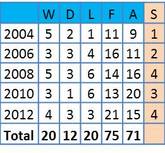
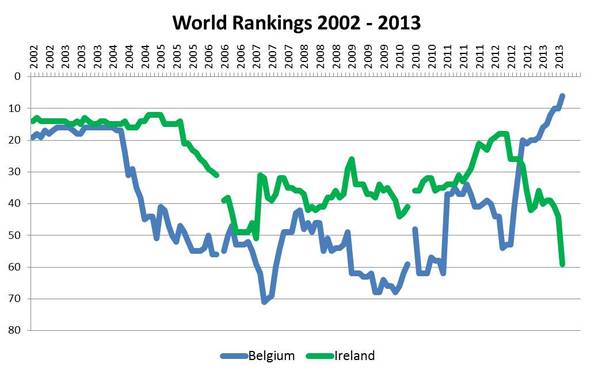
Their record from 2002 to 2012 has not been impressive. The table beside outlines their qualification performance and  seeding (column S) in Euro’s 2004, 2008 and 2012 and World Cup’s 2006 and 2010. The country failed to qualify for a single tournament in this period. In fact, Belgium hit an all-time low in the Coca-Cola FIFA World Rankings in June 2007 when they were ranked 71 in the world.

However since mid-2012 this has all begun to change. The Belgian’s are now ranked six in the world! The contrast in fortunes with the Republic of Ireland in the past twelve months is stark.

On the plus side for the Irish set-up, this goes to prove that our current slide is in no way irreversible. In fact, as late as June 2012 Belgium were ranked 54 in the world and Ireland 18. Maybe before the FAI hire a new manager they should send someone to Belgium for the weekend and find out what they’ve done recently…quite a lot, it seems.

Picture

Football as a successful institution

21/9/2013

 
by Declan Jordan
In a recent blog post Duncan Green asks why football has been such a successful and replicable institution around the world. As he puts it:
Why is football such a brilliant and replicable institution?

Think about it. Institutions are often defined as ‘the rules of the game’. The work of Matt Andrews, ODI and an increasingly large phalanx of other researchers argue that such rules have to emerge from local context. You can’t use a cookie cutter to graft Westminster democracy or any other institution onto poor countries.

Except for football (OK, soccer, for some of you). Now there is a perfect universal set of ‘rules of the game’. In fragile states such as Papua New Guinea, few people accept Western notions of governance, but they all accept the offside rule. A single set of rules is followed apparently by grassroots and elite alike in more or less every country in the world. Why is that?

The post has generated some really interesting responses in the comments section.

It is argued that the same rules of the game apply everywhere and this implies a well functioning institution. I also think the argument for clearly defined incentives is a strong one.

However, while rules are clearly defined and accepted across the world it is not the case that football culture is the same across the footballing world. Different countries have different ways of playing and behaviours that are acceptable in one football culture are not acceptable in another. This is more than the cliché of foreign players in England being prone to diving or that the game in Britain is more physical and less technical. 

In Brilliant Orange: The Neurotic Genius of Dutch Soccer, David Winner argues that Dutch football's success is partly due to Dutch people's need to think differently about space and it's uses as a large population squeezed into a small space. In a review of the book here, Timothy Dugdale also refers to Winner's argument that brazilian football is so creative "precisely because its society has yet to impose 'progress' upon it". The benefits to Dutch football from its society's open attitude to immigrant influences is also cited.

So, while rules of the game have replicated and there is no doubt that football is a successful institution, the other aspects of institutions, such as culture, remain differentiated. Perhaps this is an indication of an even greater success of global football that it can accommodate heterogeneity in styles and approaches while maintaining the rules and organisations.

Translating Underage Success

20/9/2013

1 Comment

 
By John Considine
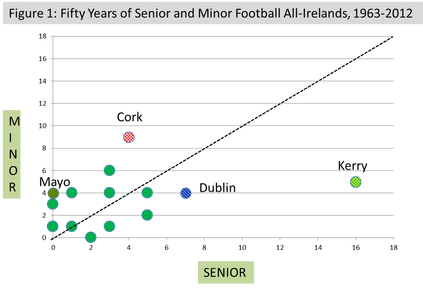
On Sunday Mayo will attempt to win their first senior All-Ireland in over 60 years.  The county will also contest the minor (under 18) final.  In the last 50 years Mayo has managed a handful of All-Ireland football titles at both minor (under 18) and under-21.  However, Mayo have had difficulty converting underage success into senior success.  Figure 1 illustrates this situation.  Mayo have won 4 minor titles over the last 50 years but no senior title.  Their opponents on Sunday have also won 4 minor titles during the period, however, Dublin have won more senior title than minor titles during that period.  Dublin have 7 senior titles.

It is interesting to note that the two most successful senior sides during the period have not had the same success at minor level.  Kerry have been the senior kingpins but have not won a minor title since 1994.

In Figure 1 the counties above the diagional dotted line have relatively more minor titles than senior titles whereas those below the line have more senior titles than minor titles.
Picture
1 Comment

A Handy Tool for Hurling Statistics

20/9/2013

 
If you want statistics on hurling then check out Expert Database Solutions Ltd (here).

Protectionism in the Premier League

19/9/2013

0 Comments

 
by Declan Jordan
Picture
I'm not sure if it's every season but it seems to be that there is an annual collective wringing of hands in the English media about the lack of domestic players in the Premier League. The most recent cheerleader for the 'too-many-foreigners' brigade is Gary Neville. But he is not the only one. His former team mate, Rio Ferdinand, said it was a disgrace that only 3 of the players starting the Manchester City - Newcastle game were English. And others are equally as strident here and here.The FA Chairman Greg Dyke suggested restrictions on foreign players may be in the offing and he criticised the transfer dealings of Sunderland and Newcastle.

It seems the English league is suffering the same angst as the English electorate that results in protectionism and votes for the UK Independence Party.

The kernel of the argument over the number of foreign players in the Premier League is that it hampers the performance of the English national team. As Gary Neville put it:

Everyone who is supportive of the England national team will have grave concerns over the dwindling numbers of Premier League players that are British.
Why more Welsh and Scottish players would help the English team is unclear but the idea seems to be that by forcing Premier League clubs to play more English players there will be better quality players available for the national side. This is because foreign players are keeping talented English players out.

There are a few ways to come at this argument but it boils down to a protectionist argument with which economists will be very familiar. In fact one of the classic expressions (albeit satirical) of the protectionist approach was in Bastiat's Candlemakers' Petition in 1845. The Greg Dyke/Gary Neville argument seems to be "please keep out these foreign players because they are too good for our guys to get a run. If we could just get a run we'd be better players".

There has been a dramatic increase in the number of foreign players in the Premier League. This year there will be 450 players from outside Britain and Ireland in the Premier league compared to 13 in the inaugural season in 1992/3. Of course the claim that fewer foreign players would improve the performance of the English team begs the question why the English team performed so badly when there were very few foreign players in the top flight of English football.

Leaving aside that obvious flaw in the argument, there is a more fundamental flaw in the argument that clubs should increase the number of home grown players. That is that it is not any business of the clubs how the English team performs. They are answerable to their owners and perhaps to an extent their own fans, not the FA. Managers and clubs should field the strongest possible team they can and whether that includes 11 or no Englishmen can't be a consideration. A club manager will hardly be saved from the sack by leading a team of Englishmen to relegation. And it does seem that there is a relationship between league performance and the number of foreign players.

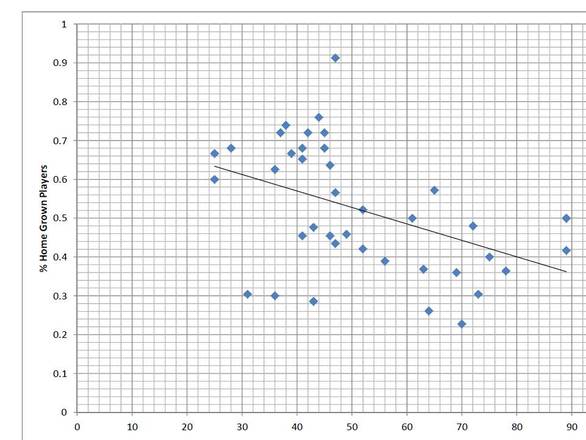
Each club is required to submit a squad of no more than 25 players, of which a maximum of 17 may be foreign, the balance must be 'home-grown'. A home grown player is one who has been registered with an English or Welsh club for 3 season before he is 21. The graph below shows the percentage of home grown players at the end of the September transfer window and the final points total for the last two full Premier League seasons. It shows a negative relationship between the percentage of home grown players and league performance. The percentage does not include under-21 players who may be entered in a separate list and do not have quotas attached. Also, there is no inference of causality. It is not clear whether better performance leads to less home grown players in the squad or fewer home grown players leads to better performance.
Picture
It does suggest however that the better clubs (based on performance) are more inclined to have foreign players. It may be that that those players are more expensive and so can only be afforded by the richer clubs and their income is a function of league position. Or it may be that managers hire the best players and their nationality is irrelevant.

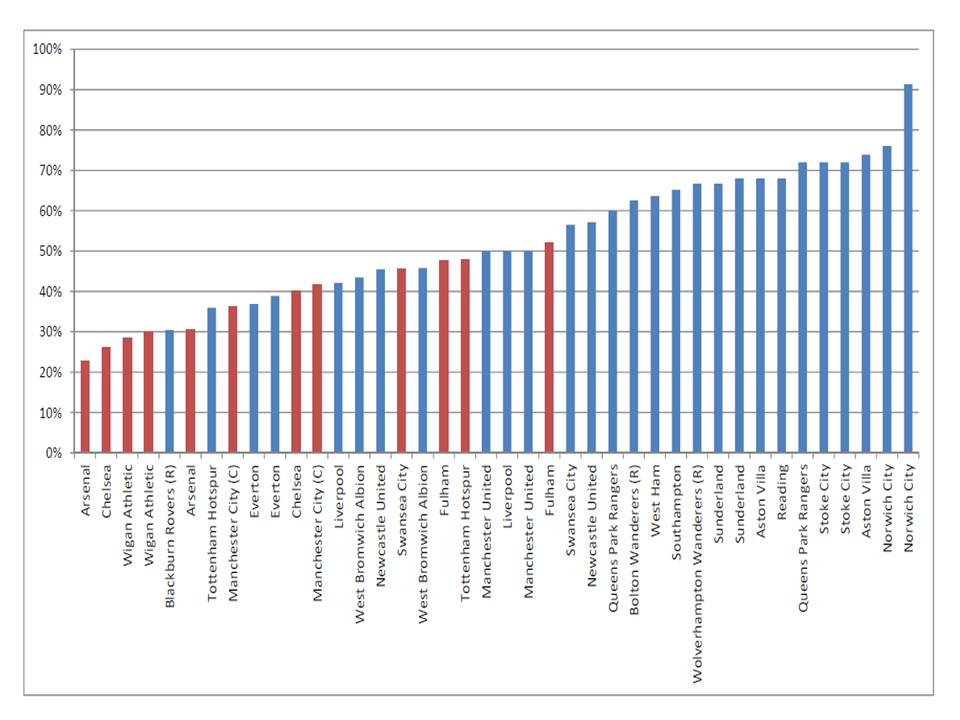
A second consideration in the number of non-home grown players may be the nationality of the manager of a club. A foreign manager may be more inclined to sign foreign players or to be more aware of foreign players that fit his system. Gary Neville hinted at this in a recent article. The graph below shows the percentage of home grown players for each club in the Premier League for the last two full seasons (so most clubs appear twice). The clubs in red had a foreign manager (meaning not British or Irish) at the start of that season (only one club switched from an English manager to a foreign manager between the two seasons - that was Tottenham Hotspur who appointed Andre Villas Boas to replace Harry Redknapp).
Picture
The clear bias of blue bars towards the right hand side of the graph suggests that there may be a bias among British and Irish managers (the final bar is Norwich City managed by Irishman Chris Hughton), towards home grown players. The median percentage of home grown players among clubs with a foreign manager is 40% while it is 62.5% for non-foreign managers. As might be expected from the first graph, the clubs towards the right hand side of the graph are those featuring in the lower half of the league table. 

So the upshot is that if the FA wishes to limit foreign players it may be easier to do so by limiting foreign managers. Though why they would want to reduce the quality of their product that sells across the globe without any evidence that it might improve the national team performance is not clear to me. In fact, part of the success of the Premier League is due to it's popularity around the world and that is possibly due to the presence of players from around the 
world.

The Premier League has benefited from globalisation. It would be retrograde to adopt a protectionist policy to player recruitment.
0 Comments

The Business of the NFL

18/9/2013

 
Bloomberg's Sportfolio programme had a recent episode examining the business of the NFL (here).  There is an interesting discussion on the ways in which fans "see" the game and the role of technology.  The episode includes a brief discussion of the games played in London and other ways of bringing the game overseas.  In a more extended piece, Rick Horrow talks to Joe Banner about rebuilding the Cleveland Browns.

Faint Praise

18/9/2013

 
The week's edition of The Economist carries a less than flattering review of Gregg Easterbrook's book The Kings of Sport: Football's Impact on America (here).
<<Previous
Forward>>

    Archives

    May 2026
    April 2026
    March 2026
    February 2026
    January 2026
    December 2025
    November 2025
    October 2025
    September 2025
    August 2025
    July 2025
    June 2025
    May 2025
    April 2025
    March 2025
    February 2025
    January 2025
    December 2024
    November 2024
    October 2024
    September 2024
    August 2024
    July 2024
    June 2024
    May 2024
    April 2024
    March 2024
    February 2024
    January 2024
    December 2023
    November 2023
    October 2023
    September 2023
    August 2023
    July 2023
    June 2023
    May 2023
    April 2023
    March 2023
    February 2023
    January 2023
    December 2022
    November 2022
    October 2022
    September 2022
    August 2022
    July 2022
    June 2022
    May 2022
    April 2022
    March 2022
    February 2022
    January 2022
    December 2021
    November 2021
    October 2021
    September 2021
    August 2021
    July 2021
    June 2021
    May 2021
    April 2021
    March 2021
    February 2021
    January 2021
    December 2020
    November 2020
    October 2020
    September 2020
    August 2020
    July 2020
    June 2020
    May 2020
    April 2020
    March 2020
    February 2020
    January 2020
    December 2019
    November 2019
    October 2019
    September 2019
    August 2019
    June 2019
    May 2019
    April 2019
    March 2019
    February 2019
    January 2019
    December 2018
    November 2018
    October 2018
    September 2018
    August 2018
    July 2018
    June 2018
    May 2018
    April 2018
    March 2018
    February 2018
    January 2018
    December 2017
    November 2017
    October 2017
    September 2017
    August 2017
    July 2017
    June 2017
    May 2017
    April 2017
    March 2017
    February 2017
    January 2017
    December 2016
    November 2016
    October 2016
    September 2016
    August 2016
    July 2016
    June 2016
    May 2016
    April 2016
    March 2016
    February 2016
    January 2016
    December 2015
    November 2015
    October 2015
    September 2015
    August 2015
    July 2015
    June 2015
    May 2015
    April 2015
    March 2015
    February 2015
    January 2015
    December 2014
    November 2014
    October 2014
    September 2014
    August 2014
    July 2014
    June 2014
    May 2014
    April 2014
    March 2014
    February 2014
    January 2014
    December 2013
    November 2013
    October 2013
    September 2013
    August 2013
    July 2013

    About

    This website was founded in July 2013.

    RSS Feed

    Categories

    All
    American Football
    Athletics
    Baseball
    Basketball
    Behavioural Economics
    Boxing
    Broadcasting
    Competitive Balance
    Cricket
    Cycling
    Darts
    David Butler
    Declan Jordan
    Drugs
    Ed Valentine
    Epl
    Esports
    Expenditure
    F1
    Fifa World Cup
    Finances
    Funding
    Gaa
    Gaelic Games
    Gambling
    Game Theory
    Gary Burns
    Geography
    Golf
    Greyhound Racing
    Guest Posts
    Horse Racing
    Impact Studies
    John Considine
    John Eakins
    League Of Ireland
    Location
    Media
    Mls
    Mma
    Olympics
    Participation
    Paul O'Sullivan
    Premier League
    Regulation
    Research
    Robbie Butler
    Rugby
    Simpsonomics
    Snooker
    Soccer
    Spatial Analysis
    Sporting Bodies
    Stephen Brosnan
    Swimming
    Taxation
    Teaching
    Technology
    Tennis
    Transfers
    Uefa
    Ufc
    World Cup
    Wwe

Powered by Create your own unique website with customizable templates.