The Economics of Sport
  • Sports Economics
  • About
  • Workshop
  • Selected Publications
  • Book Reviews
  • A Primer on Gaelic Games
  • Upcoming Events
  • Media
  • Education
  • Resources & Links

Hedonic Utility And The Republic of Ireland

27/3/2024

 
By Robbie Butler

Over coffee today, we spoke about the recent performance of the Republic of Ireland football team, and a colleague of mine reminded me of a concept I had been introduced to over two decades ago during my undergraduate degree - hedonic utility.

For those unfamiliar with the concept - I had to be re-educated - hedonic utility is a concept in economics and psychology that refers to the pleasure or happiness derived from the consumption or experience of a good or service. It's a component of overall satisfaction that individuals derive from consuming these goods or services.

For us as individuals, hedonic utility is the subjective enjoyment or satisfaction we gain from the things they consume or experience. For example, watching the Republic of Ireland football team. This concept is used to explain utility theory, consumer behavior and preferences and acknowledges that people make decisions not only based on rational calculations of utility but also on emotional and sensory experiences associated with consumption.

Watching Ireland play last night - and lose again at home - is something I have become all too familiar with in recent years. For many fans, this is the norm, and for some, it is all they have ever really known.

I was lucky enough to be born in the early 1980s and can recall Euro '88 and both World Cups in 1990 and 1994. The utility I derived from these events has never been matched. I would say this is acutely true of the tournaments in 1988 and 1990. The Law of Diminishing Marginal Returns probably explains why. The tournaments in 2002, 2012, and 2016 were fun but not the same (especially 2012).

I also think experiencing these events as a child adds to the enjoyment. The children supporting Ireland today will probably never experience this and may have to wait until they are young adults or even older before they can support Ireland at a World Cup. This is just like every generation born in Ireland prior to the 1970s.

So, the children of Ireland today are much like my parents' generation. Supporting an international team that finds it hard to qualify for major tournaments. The memories I have of places like Stuttgart, Hanover, Valletta, Genoa, Rome, Belfast, New York, and often Dublin cannot be lost. The hedonic utility I gained is almost immeasurable. It was great to be born in the early 1980s.
The Saudi Pro League – Another Failed Experiment?

25/3/2024

 
By David Butler

It is estimated that Saudi Arabian clubs spent about £780 million importing players last summer. This spend is mostly down to four clubs - Al Ittihad, Al Ahli, Al Nassr and Al Hilal (“The Public Investment Fund”).

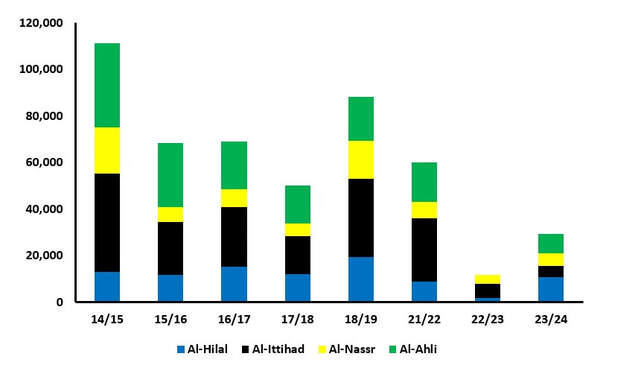
The latest attendance figures for these clubs does not make for pretty reading, and supposedly the same level of investment in players going forward will not be sustained.  This poses a challenge for big European clubs who had the Saudi valve to get aging and big contracts players off the books.

Other leagues have attempted to revolutionise themselves through spending before and typically this ends in a failure – the Chinese league tried to do this some time ago too.  If anything, the data suggests there is a declining trend for the biggest clubs who regularly are in the top 3 or 4 finishing positions (note that Al-Ahli were relegated so only 3 of the big clubs participated in 22/23). The graph below shows average attendances for the ‘big-4’  since 14/15.
​
Perhaps the motivations were not to grow the league? If the aim was to host the World Cup rather than stimulate fan interest – this may well have been the investment required to bring credibility to the domestic league. The spending may have been worth it. I can never see European or American fans tuning in regardless of the talent on display.  It is notable that claims of a wind down in player investment comes after Saudia Arabia were announced as host of World Cup 2030. 
Picture

James Quirk Memorial Prize in Sports Economics Winner 2024

21/3/2024

 
By Robbie Butler

Last week University College Cork held its annual prize-giving ceremony in the College of Business and Law. The event marked the second time that the University has awarded the "James Quirk Memorial Prize in Sports Economics".

James (Jim) Patrick Quirk (November 27, 1926 – June 4, 2020) was a Caltech Professor of Economics. He was also Professor of Economics at the University of Kansas and is widely regarded in the field of sports economics. Prof Quirk was one of the first ever “sports economists” and made his seminal contributions to the subject, as early as the 1970s, which continued for the next 40 years.

Prof Quirk is of Irish decent and the Quirk estate are pleased to support an annual prize in University College Cork’s “Economics of Sport” module to remember the lifetime of contributions made to this field. This award is presented to the student with the best academic performance annually in EC3219.

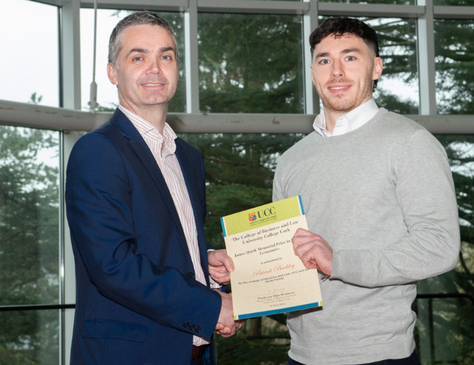
The 2024 winner was BA (Economics) graduate Patrick Buckley pictured below with the Dean of Cork University Business School Professor Anthony McDonnell. 
Picture
Well done Patrick!

Howard Webb and Imposing Penalties

21/3/2024

 
By John Considine
Picture
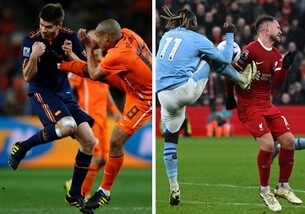
Howard Webb refereed the 2010 FIFA World Cup final where he famously decided not to give a red card 25 minutes into the game – and later admitted he got it wrong.  He now heads up the Professional Game Match Officials Board.  In a Sky TV interview earlier this week, he justified a recent decision by another referee and the VAR system not to give a penalty in a Liverpool versus Manchester City game.
 
In explaining the non-penalty decision, Webb used words like "threshold" and "certainty" many times. Webb was effectively saying that referees require a higher degree of certainty when it comes to giving penalty kicks.  He clearly implied that the burden of proof is higher later in games.  Webb seems to be giving the same guidelines to soccer referees that was provided to NBA officials two decades ago.  The words in the Comments on the Rules: I. Guides for Administration and Application of the Rules say, "there are times during a game where 'degrees of certainty' are necessary to determine a foul during physical contact. This practice may be necessary throughout the game with a higher degree implemented during impact times when the intensity is risen, especially nearing the end of a game.”
 
I have taken the above quote from a Georgetown Law Journal article by Mitchell Berman.  It is called “Let ‘em Play” and I would recommend it to anyone interested in games.  Towards the end of the article, Berman has a section called “A wart on the beautiful game”.  The wart is that the red card removes the offender from the field for the remainder of the game.  That length of time is variable depending on when the player is dismissed.  It could be 65 minutes or 65 seconds.  In 2010, would Webb have sent off the player in the orange shirt above if there was 65 seconds rather than 65 minutes left in the game?
 
A few months ago, a VAR-weary world dismissed the idea of a blue card in soccer.  It was going to be something between a yellow card and a red card.  It would have removed the offender for a fixed-length period from the game.  It was compared to the 10-minute "sin-bin" used in rugby union for yellow cards.  Now rugby union is trialling a 20-minute penalty for the red card where the offender is removed but can be replaced after 20 minutes.  It looks like both sports are moving in the direction of American football when it comes to removal of individual players.

"One option would be to not allow Irish trained runners in the UK"

20/3/2024

 
By Robbie Butler

Last week I wrote about the Presbury Cup at Cheltenham. To remind readers, the cup is awarded based on the total number of winners trained in Great Britain versus those trained in Ireland over the four days of the festival. The nation with the most winners at the end of the festival is declared the winner of the cup.

Yet again, the away team (Ireland) won the Prestbury Cup. The scoreline 18 – 9.

This is the 9th year in a row where Team GB have failed to win the trophy outright (draw in 2019) and has forced many to question why British racing cannot compete with Ireland. Various theories and solutions have been forwarded but the most explosive was probably that of Grand National winning trainer Richard Newland.

The article is worth reading as it speaks directly to competition in races and competitive balance (or lack thereof).

In one part Newland says:
“One option would be to not allow Irish trained runners in the UK and make them non-eligible for the majority of our races…if they make Irish trained horses ineligible, the bigger UK owners would return to having their horses trained by UK trainers and the trend would start reversing…All the BHA (British Racing Authority) can do is control its own racing. They can do that by saying the Irish are not eligible to run in UK jump races or charge much higher entry fees”.

The full piece can be read here.

The protectionism of domestic races advocated by Newland is astonishing when one considers the history of Irish horses at the festival and demonstrates the extent of dominance of Irish-based horses today. It is a far cry from 1989 – a Cheltenham blank for Ireland – and this Irish monopoly of almost all  Grade 1 races is a relatively new phenomenon.

The article has Brexit undertones – ‘we are better alone’ or ‘tax foreign entries’ – and fails to answer the key question. Why do so many English owners locate horses in Ireland? Maybe Irish trainers are simply better. Recent data would support this. 

An Overview Of Formula One Today

20/3/2024

 
By Robbie Butler

The link below provide a nice summary of the economics of Formula One today. It was written by RTE Business Journalist Adam Maguire.

Drive to Thrive: F1's money-making formula.

It may be of interest to F1 fans and those interested in learning more about the economics of the sport.

ESEA 2024 Deadline

13/3/2024

 
By Robbie Butler

The 2024 European Sport Economics Association Conference will be hosted by the Erasmus School of Economics and will take place from 21 to 23 August 2024 in Rotterdam (Netherlands).

Researchers are invited to submit a paper for the 15th annual meeting. Submissions are welcome relating to any area of sports economics, including theoretical, empirical, and conceptual papers. Completed research and research in progress are equally admissible, but manuscripts already accepted for publication should not be submitted. The conference language is English.

The deadline for submissions is this Friday, 15th of March 2024. 

​Other key dates are below.
  • 1 May, 2024 – Notification of acceptance
  • 15 July, 2024 – Submissions of full papers for the ‘Best Young Researcher Paper Award’
  • 15 July, 2024 – Deadline for registration for presenting authors
  • 31 July, 2024 – Deadline for registration for non-presenting participants
  • 19 - 21 August, 2024 – PhD workshop
  • 21 - 23 August, 2024 – ESEA conference (AGM on August 22)

The offical website can be found here.

Klopp's Final Match?

13/3/2024

 
​By David Butler

Yesterday, the media carried the story that UEFA were concerned that ticketless fans could be a problem at the Europa League final at Dublin's Aviva Stadium on 22 May. General secretary Theodore Theodoridis is quoted saying that it "would be extremely challenging to accommodate supporters if clubs with bigger fanbases reached the final".

The perfect storm would be a Liverpool vs Rangers final given the geographic location and domestic fanbases on the Island of Ireland for these clubs. This is quite unlikely however – the markets price Rangers at 16/1 to reach the final.

Liverpool themselves are however the biggest worry. They are 8/11 to reach the final and have a large fanbase in Ireland alone. This would be Jurgen Klopp's last game in charge of Liverpool; should they reach the final managing the event for UEFA will be a major challenge given the likely numbers and the wider accommodation and infrastructural issues in Dublin. There are also many other big clubs that would bring significant fanbases such as AC Milan, Roma and Marseille.

UEFA are probably hoping for some shocks. This will be one to keep an eye for those interested in event management and could be a good case study depending on how things play out. 

The Supreme Novice And Cheltenham Week

11/3/2024

 
By Robbie Butler

Tomorrow marks the start of the 2024 Cheltenham Festival. For readers unfamilir with this annual sporting event, the 4-day festival is one of the most prestigious events in the world of horse racing. It takes place annually at Cheltenham Racecourse in south-west England. 

The highlight of the Cheltenham Festival is the Cheltenham Gold Cup (run on Friday), a Grade 1 National Hunt race that is considered the pinnacle of steeplechasing. Other notable races during the festival include the Champion Hurdle (Tuesday), the Queen Mother Champion Chase (Wednesday), and the Stayers' Hurdle (Thursday).

The festival attracts top horses, jockeys, trainers, and spectators from around the globe. It is known for its lively atmosphere, high-quality racing, and the significant amount of betting that takes place during the event. This is particualry true of Irish racing fans with it sometimes joked that the Cheltenham Festival is the biggets racing event in Ireland.

In recent years the role and performance of Irish trained horse and owners has dramtically improved. It is not that long ago that Ireland would leave the Fesitval with a single-digit winner's total. In fact, in 1989 not a single Irish horse won at the then 3-day festival. Such an outcome would be unthinkable now and the growing competition between Ireland and Great Britain allowed for the creation of the Prestbury Cup in 2014. 

The cup is awarded based on the total number of winners trained in Great Britain versus those trained in Ireland over the four days of the festival. The nation with the most winners at the end of the festival is declared the winner of the cup.

The problem with this now is that there is almost no competition. Ireland are 1/16 to have more winner that Great Britain. Irish domination may also be captured by the number of entries in each race. For example, on Day 1 of the festival in 2009 (15 years ago) 100 horses entered the 7 races. This year that number on Day 1 will be below 50.

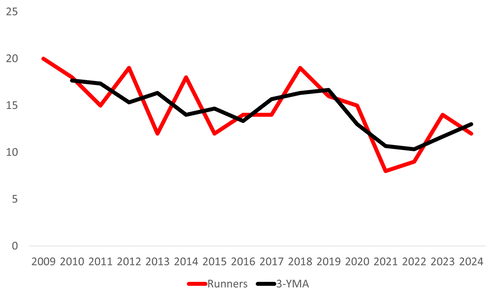
The very first race - the Supreme Novice Hurdle - can demonstrate the trend. Below is data for the past 15 runnings (including entries for tomorrow). 
Picture
The trend is downwards, as is the 3-year moving average. The question is why?

Is this a general trend in horse racing? Smaller field sizes, even in the most coveted races? Possibly. The data from the BHA would suggest this is an issue.

Might it also be the case that an erosion of competitive balance is incentivising trainers to run horses in other races as they fear they cannot compete would some of the powerful, often Irish-based, trainers and horses? Or maybe skip the Festival entirely and instead target Aintree or Sandown, where the Irish presence is dramtically lower.

Public Funding for a Stadium in Manchester?

9/3/2024

 
By John Considine
Six days ago, Manchester United’s Marcus Rashford scored a goal in a stadium built with public money.  The Etihad Stadium was originally built as a potential host of the Olympics and actual host of the 2002 Commonwealth Games.  It was a time when Manchester United were perched at the top of English football.  It was only four years since Manchester City had graced the third-tier of English football.  Soon after the 2002 Commonwealth Games, City moved to the stadium.  Few now consider that they might have been in receipt of aid from the State.  Nowadays the concern is about the aid they might be receiving from State funds coming from outside the United Kingdom.
 
The clouds on Manchester City’s horizon are off the field.  They concern finance.  Manchester United fans might suggest that their own on-field troubles stem from off-field finance.  And, they seem to be thinking that Jim Radcliffe's recent purchased a minority share in the club will solve their on-field problems.  The new minority owner has expressed a view that public money might be used to fund the redevelopment of Old Trafford.  Should Manchester United get public money to fund the redevelopment of Old Trafford?
 
Brexit does not mean that the British government can now fund another stadium in Manchester without reference to EU State Aid rules.  Despite yesterday’s result, there is a good chance Manchester United will again play in UEFA competitions!  Will competition be distorted by the granting of State Aid?  Having looked at a few of these State Aid decisions, I'm convinced that any political decision will be wrapped in enough motherhood, apple pie, and waffle(s) to justify it.
 
Manchester United can point to their rivals in the Premier League and ask a few questions about how they are owned and funded.  The Etihad Stadium is one example.  What about the stadium that was constructed to hold the London 2012 summer Olympics and is now home to West Ham?  Could Sovereign Wealth Fund ownership of a Premier League club like Newcastle be viewed as State Aid?
 
Games in UEFA’s 2028 European Championships will be hosted by the Etihad and Newcastle’s St James’s Park.  Everton’s uncompleted new home venue is also pencilled in as a venue.  Everton have recently encountered their own financial issues that have resulted in a 10-point deduction (later reduced to 6 points).  Will the UK government stump up some money to aid the completion of Everton's new home?
 
Will the UK government provide the support to complete Casement Park – another venue scheduled to hold Euro2028 games and located in another city associated with Marcus Rashford.  At least in that situation the EU has cleared State Aid (see SA.37342) - although the decision says that the aid was time limited.  Plenty of waffle in that decision.  An important consideration is known as the Belfast Agreement – an agreement that has reduced political violence on the island of Ireland.  The agreement was facilitated by George Mitchell who was to produce the Mitchell Report on the use of drugs in baseball.  The State Aid was to facilitate "shared spaces" but the EU Commission cleared the funding of three stadia which arguably embedded the segregation they waffled on about helping to end.  Maybe a revamped Old Trafford could be said to being noisy neighbours closer together!

It is worth comparing the reasoning in that State Aid decision with the reasoning provided for the redevelopment of a stadium south of the Irish border around the same time (see SA.44439).  Here the EU Commission cleared funding on the basis of more inclusive usage!  The Commission cleared funding and agreed with the views that the stadium would not be built in the absence of State Aid because of a market failure.  Most economists might see "red" on the issue of claimed market failure.  But there are more basic questions the Commission might ask in these situations.  Was the original stadium, that is now being redeveloped, built without State Aid?  Are there other stadia in Ireland being built without State Aid?  One must ask about the attention given by the EU Commission to their analysis.  This should have been obvious when they first mentioned the GAA in their decision.  At least the Commission got the G(aelic) and last A(ssociation) correct.  Sloppy?  Or where they just looking to write up a decision that had already been made?

Why not public funding for Manchester United.

<<Previous

    Archives

    December 2025
    November 2025
    October 2025
    September 2025
    August 2025
    July 2025
    June 2025
    May 2025
    April 2025
    March 2025
    February 2025
    January 2025
    December 2024
    November 2024
    October 2024
    September 2024
    August 2024
    July 2024
    June 2024
    May 2024
    April 2024
    March 2024
    February 2024
    January 2024
    December 2023
    November 2023
    October 2023
    September 2023
    August 2023
    July 2023
    June 2023
    May 2023
    April 2023
    March 2023
    February 2023
    January 2023
    December 2022
    November 2022
    October 2022
    September 2022
    August 2022
    July 2022
    June 2022
    May 2022
    April 2022
    March 2022
    February 2022
    January 2022
    December 2021
    November 2021
    October 2021
    September 2021
    August 2021
    July 2021
    June 2021
    May 2021
    April 2021
    March 2021
    February 2021
    January 2021
    December 2020
    November 2020
    October 2020
    September 2020
    August 2020
    July 2020
    June 2020
    May 2020
    April 2020
    March 2020
    February 2020
    January 2020
    December 2019
    November 2019
    October 2019
    September 2019
    August 2019
    June 2019
    May 2019
    April 2019
    March 2019
    February 2019
    January 2019
    December 2018
    November 2018
    October 2018
    September 2018
    August 2018
    July 2018
    June 2018
    May 2018
    April 2018
    March 2018
    February 2018
    January 2018
    December 2017
    November 2017
    October 2017
    September 2017
    August 2017
    July 2017
    June 2017
    May 2017
    April 2017
    March 2017
    February 2017
    January 2017
    December 2016
    November 2016
    October 2016
    September 2016
    August 2016
    July 2016
    June 2016
    May 2016
    April 2016
    March 2016
    February 2016
    January 2016
    December 2015
    November 2015
    October 2015
    September 2015
    August 2015
    July 2015
    June 2015
    May 2015
    April 2015
    March 2015
    February 2015
    January 2015
    December 2014
    November 2014
    October 2014
    September 2014
    August 2014
    July 2014
    June 2014
    May 2014
    April 2014
    March 2014
    February 2014
    January 2014
    December 2013
    November 2013
    October 2013
    September 2013
    August 2013
    July 2013

    About

    This website was founded in July 2013.

    RSS Feed

    Categories

    All
    American Football
    Athletics
    Baseball
    Basketball
    Behavioural Economics
    Boxing
    Broadcasting
    Competitive Balance
    Cricket
    Cycling
    Darts
    David Butler
    Declan Jordan
    Drugs
    Ed Valentine
    Epl
    Esports
    Expenditure
    F1
    Fifa World Cup
    Finances
    Funding
    Gaa
    Gaelic Games
    Gambling
    Game Theory
    Gary Burns
    Geography
    Golf
    Greyhound Racing
    Guest Posts
    Horse Racing
    Impact Studies
    John Considine
    John Eakins
    League Of Ireland
    Location
    Media
    Mls
    Mma
    Olympics
    Participation
    Paul O'Sullivan
    Premier League
    Regulation
    Research
    Robbie Butler
    Rugby
    Simpsonomics
    Snooker
    Soccer
    Spatial Analysis
    Sporting Bodies
    Stephen Brosnan
    Swimming
    Taxation
    Teaching
    Technology
    Tennis
    Transfers
    Uefa
    Ufc
    World Cup
    Wwe

Powered by Create your own unique website with customizable templates.