The Economics of Sport
  • Sports Economics
  • About
  • Workshop
  • Selected Publications
  • Book Reviews
  • A Primer on Gaelic Games
  • Upcoming Events
  • Media
  • Education
  • Resources & Links

"An Absolute Joke" And Handball

29/9/2020

 
By Robbie Butler & Ed Valentine

"It's an absolute disgrace. An absolute joke." These were the words of Sky Sports pundit Jamie Carragher following the awarding of a penalty to Newcastle United against Tottenham on Sunday when Eric Dier had the ball headed off his arm, while looking the other way. 

It is hard to disagree with Carragher. The new interpretation of handball by Premier League referees and VAR is a joke. In fact, it is quite incredible (to us at least) how often the ball seems to strike the arm of a player in the lead up to a goal or penalty. Before the introduction of VAR almost everyone had a fair idea of what was handball and what was not.

​Prior to the introduction of VAR it was assumed that the technology could deal with the likes of Diego Maradona and Thierry Henry - instances where the hand is deliberately used to control ball. I also assumed we might see VAR used 5-6 times per season. "Oh did you hear VAR was used in the game between...",  just like Goal Line Technology. Instead VAR is eating the game. In the search for consistency with handballs, the unintended consequence has been the awarding of almost anything when the ball hits the arm - deliberate or not. 

Some handballs are clear cut - like the two mentioned above - others are not. This is why there is a referee. To make those calls. People will disagree. So be it. Football had survived (and thrived) for 150 years this way.

​If the rules continues as they currently are, another unintended consequence will be countless penalties in each game. The data below (supplied by Opta) can illustrate this. 
The bar chart to the right shows the number of penalties awarded and scored in the first three game weeks of the Premier League, for the past three seasons.

2018-19 is pre-VAR and actually reports a higher number than 2019-20 when VAR was first used in the league. 

This season has witnessed a huge jump in the number of penalties awarded, half of which have been for handball. The 2020-21 figures, for the first 30 games, are already more than the two seasons previous combined. 
It is projected that the overall number of penalties could reach nearly 300 this season if this continues. That is not far off one per game. Penalties will become the norm - rather than the exception they once were - if this continues and handball will probably be the source of many of these.

Radio Broadcasts and Television Rights

25/9/2020

 
By Robbie Butler

In May 2019 Irish national radio station Today FM broadcast its final episode of Premier League Live. The radio station had provided live coverage of a Saturday 3pm kick-off to radio listeners, and no doubt countless others online, for 21 consecutive seasons. I must admit, despite often listening to the show on the radio, I did not become aware of the decision to end the broadcast until the start of the 2019-20 season. 

I was both disappointed and surprised that the show had come to an end. For me, it was something that I habitually listened to on Saturday's and acted as a reference point in both my week and calendar year. As I reflected on the ending of the show in the weeks ahead, my surprise at the decision declined, but my disappointment remained. However, the game has changed over the past 21 years and the decision to end Premier League Live probably reflected this - and all of this before Covid-19. 

When I think of my consumption of the show it primarily occurred while I was in a car. I wonder how many others were in the same position? If I didn't happen to drive on Saturday afternoon, I probably didn't listen. 

A second issue must have been the television schedule that has become more and more important in recent seasons. The 3pm Saturday kick-off is now the home of many of the lesser games during the season. The 'big' fixtures generally take place at lunchtimes on Saturdays, on Sunday afternoons or Monday evenings. I wonder how much demand for listening was impacted by the games taking place.

The arrival of a 3pm game on television - the blackout does not apply in Ireland - was no doubt another blow to the radio show. Sometimes the game on TV was the same as that broadcast on radio. Of course, the televised game was behind the paywall, but could be viewed in most pubs.

And one has to wonder if the show would have survived this season, had it not been cancelled. The continuation of football behind closed doors means almost every game has a different kick-off time. Every game is broadcast on television, making the radio an inferior good. Well for most anyway.

With television today effectively having a match on numerous times a day, every day of the week, radio broadcasts may soon be a thing of the past entirely. 

Determinants Of Demand For Boxing Broadcasts

18/9/2020

 
By Robbie Butler,

Following on from recent publication successes in the Scottish Journal of Political Economy and European Journal of Operational Research, we were delighted to be accepted recently in European Sports Management Quarterly (ESMQ).  

The paper "New Insights on the Louis-Schmeling Paradox: Determinants of Demand for Subscription and Pay-Per-View Boxing" is co-authored with blog contributor David Butler and Head of Department, and Professor of Economics at Drexel University, Joel Maxcy. 

Despite its longevity and historical importance, boxing is a sport almost devoid of attention in the sports economics literature. To remedy this we created two new datasets and asked what are the determinants of main event broadcasting viewership and pay-per-views buys? In addressing this question we offer new insights on the uncertainty of outcome hypothesis [UOH] and extend research on direct demand for an individual sport.

For main events, we find conflicting evidence to the UOH. Fans show a preference for rematches, domestic boxers and heavier divisions. NFL broadcasts and earlier scheduling negatively impact viewership. For pay-per-views, we find a positive price effect - largely thanks to Floyd Mayweather Jr. Both types of broadcasts exhibit a negative trend with viewership and PPV buys declining over the period of time we examine.

The paper is currently in press and will be available shortly from ESMQ.

From Paris To Berlin (And Most Other Western European Capitals)

3/9/2020

 
By Robbie Butler

Just like John in the post before this one, I too watched Stage 5 of the Tour de France. However, unlike John, my motivation was not to watch the cycling but rather the route in southern France that finished in the small town of Privas.

Most people (French people that I have met included) have never heard of Privas. With a population of less than 10,000 people it is easy to understand why. However, the town is a commune of France, and capital of the Ardèche department, the smallest administrative centre of any department in France. The reason I know is Privas is because I was lucky enough to visit the area 5 times during 2010-2013 while completing my PhD. It was fantastic to see the sprint finish into the town, along it's narrow streets, a far cry from the Champs-Élysées where the tour will finish.

And turning to Paris, where the Tour will end on the 20th of September, one can imagine that the Champions League loss is still fresh in the memory of Parisians. The end of the Tour might be a welcome distraction for many. The club's first appearance in the showpiece European game did not work out as expected. And while the champion of the Tour de France will always be crowned in Paris, the Champions League trophy has never been to the French capital.

And Paris is not alone in this regard.

One my second trip to Privas in 2010 I spent the entirety of my TGV journey from Paris Charles de Gaulle to Valence (south of Lyon) reading the wonderful Soccernomics by Kuper and Szymanski. I couldn't put it down. It was one of those rare books that I had to stop myself from reading, so as to have it for just a little longer. One of the earlier chapters recalls the success of club football teams in the European Cup. It is somewhat remarkable how so few clubs from Western capital cities have won the competition. PSG and Paris remain in this list.

The Table below lists the number of times the European Cup/Champions League trophy has been won by capital cities and regional cities in Western Europe. Just two other countries have clubs teams that have won the cup - Romania and the Former Yugoslavia. In both cases the teams were from the capitals (Steaua București (1986) and Red Star Belgrade (1991). Both were under dictatorship communists government at the time of their success. 
And this is what make the list to the left even more interesting. The obvious outlier is Spain. Real Madrid have won a remarkable 13 European titles. Adding in Lisbon (Benfica), the two national capitals on the Iberian peninsula have won 15 European Cups/Champions Leagues. It is worth noting however that both cities had authoritarian governments until the 1970s. Benefica won both titles (1961 and 1962) under this system and Real Madrid their first six. 

Western European capitals that have been fully democratic since 1945 have a pretty dismal record at winning the tournament. Ajax of Amsterdam (if you agree this is the capital and not The Hague) is the only bright spot. In fact, even London with the might of Chelsea, Arsenal and Tottenham had to wait until 2012 to win the competition for the first time. 
Berlin, Edinburgh, Rome and Paris are all devoid of success. This is not to mention Athens, Bern, Brussels, Copenhagen, etc. who will probably never boast the winner. Instead the power lies in the regional cities. Places like Munich, Milan, Liverpool, Manchester, Barcelona and Turin. And historically in cities like Birmingham, Nottingham, Hamburg, Rotterdam, Eindhoven, Glasgow, Porto and Dortmund.

Kuper and Szymanski hypothesize why this might be the case, and why capitals like Paris could emerge as winners in the not too distance future. But for now, Neymar and co. will have to wait. 

Salary Caps And The English Football League

17/8/2020

 
By Robbie Butler

Since football almost everywhere has been forced to play behind closed doors many aspects of the game have come on the radar. One such area of concern has been player salaries. This is acutely true for lower football teams where match-day income, particularly gate receipts, are a main source of income. This income has disappeared and might not return for some time as it is unlikely supporters will be allowed to attend matches in the normal fashion in the near future.

In response to the erosion of many English Football League club's primary source of income, the 2nd, 3rd and 4th tiers of the professional game have proposed the introduction of a salary cap. Such a move is largely unprecedented in recent times (in 1901 the FA introduced a salary cap that would remain until 1963) and would mark a power shift, back towards club owners. This would break the trend of the past 50+ years where players have become more and more powerful. 

Salary caps are not unusual in other sports around the world. North American sports employ salary caps quite effectively. All of the major sports in the US, with the exception of Major League Baseball (MLB) use salary caps. MLB instead uses a luxury tax.

In theory, there are two main benefits derived from salary caps. The first is that it brings greater parity between teams or competitive balance. The second is that is encourages teams to live within their means and avoids costs spiraling out of control.

Of course, not everyone is happy. The Professional Footballers' Association (PFA) - the players union - have voiced their concern. Formed on 2nd December 1907, the PFA is in its own words "the world’s longest established professional sportsperson’s union".

The union has come a long way since the "retain and transfer" system which effectively tied players to clubs, not unlike baseball's reserve clause.  For example, in 1959, George Eastham refused to sign a new contract with his club, Newcastle United, and requested a transfer. This request was declined. The source of the problem was Eastham disputing whether the house the club had supplied him was habitable and the unsatisfactory secondary job that the club had arranged. Eastham refused to play for Newcastle United in the 1960-61 season. Unable to leave, the player went on strike in early 1960. However, in October 1960, Newcastle United finally agreed to transfer the player to Arsenal for £47,500. 

As Eastham later recounted:
 “Our contract could bind us to a club for life. Most people called it   the "slavery contract". We had virtually no rights at all. It was often the case that the guy on the terrace not only earned more than us – though there's nothing wrong with that – he had more freedom of movement than us. People in business or teaching were able to hand in their notice and move on. We weren't. That was wrong”. Rebels for the Cause (2004).

Backed by the PFA, Eastham brought proceedings against Newcastle United in the High Court. In the case, Eastham v. Newcastle United [1964] Ch. 413, the judge ruled partly in Eastham's favour and the retain and transfer system was never the same again. 

It will be interesting to see how the hard fought gains since 1963, which culminated in the European Bosman Ruling in 1995, will be impacted by any such salary cap. Might we be moving back in the direction of the owners?

James Quirk and John Vrooman

29/7/2020

 
By Robbie Butler

During the course of our summer break the sad news broke that two internationally respected and renowned sports economists passed away.

On the 4th of June, James (Jim) Quirk left this world. Jim was a retired Caltech Economics Professor (1971-1987) and a leading voice in sports economics. In 1971 he published “An Economic Model of a Professional Sports League” with Mohamed El Hodiri in the Journal of Political Economy.

Professor Quirk would later go on to publish highly influential papers including Cross Subsidization, Incentives, and Outcomes in Professional Team Sports Leagues in the Journal of Economic Literature (1995) and Owner Objectives and Competitive Balance in the Journal of Sports Economics, both with Professor Rod Fort (University of Michigan), as well as “Stadiums, Arenas, and Major League Sports: The Twin Cities’ Experience”, in Sports, Jobs and Taxes: The Economic Impact of Sports Teams and Sports Stadiums (Roger Noll and Andrew Zimbalist, editors). A fitting obituary to Jim Quirk can be found here.

Just one month later, on the 5th of July, Vanderbilt University Professor Emeritus John Vrooman also left us. John was another international voice in sports economics and had been writing in the area for more than a quarter of a century. In 1995 Prof. Vrooman published A General Theory of Professional Sports Leagues in the Southern Economics Journal. This paper is cited almost 450 times to date.

John would follow this up with other notable contributions to the literature including Theory of the Beautiful Game: The Unification of European Football in the Scottish Journal of Political Economy (2007) and Theory of the Perfect Game: Competitive Balance in Monopoly Sports Leagues (2009) in Review of Industrial Organization. Until last month he kept
​the "Sports Econ Blog" active. His last post is dated June 11th 2020. An obituary to John Vrooman can be found here.

May they both rest in peace.

Reductions In Horse Racing Prize Money

3/6/2020

 
By Robbie Butler

Horse racing seems to be the sport that dropped the curtain on sport quite late on these islands  (late March). The Cheltenham Festival inexplicably continued as normal until sport was called to a halt in the UK the following week. Irish horse racing went on for longer with Thurles being broadcast in free-to-air television in the UK. 

 The curtain was raised  again this week. With racing in the UK returning at Newcastle on Monday, and Kempton Park yesterday, the show is very much back on the road. The 2,000 and 1,000 Guineas will be held at Newmarket over the weekend, while Irish horse racing will return at Naas next Monday the 8th of June.

One noticeable difference to the before and after Covid break has been the reduction in prize money on offer. The table below provides an overview of some aspects of this. 
Picture
The difference between Ireland and Great Britain are listed. While not identical, there are similarities. British races will see an increase in prize money at the lowest end of the races. Class 5 and Class 6 races are now more valuable. This is not the case in Ireland. Maybe this is because about 2/3 of all prize money is sourced from exchequer funds. 

Bankruptcy And The English Football League

27/5/2020

 
Picture
By Robbie Butler

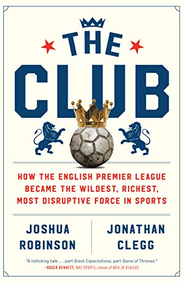
The Club by Joshua Robinson and Jonathan Clegg is an excellent overview of the rise of the English Premier League told through fascinating stories of those of involved. There is a book review on this site if anyone wants to know more. Gary Neville's recent comments about how English Football League clubs are in grave financial peril got me thinking about one of the stories in the book.

According to Neville the top tier clubs in the Premier League, and not the British Government, should bail out clubs in the lower leagues that face bankruptcy. MP Damian Collins claims this could be 10 clubs in the coming days. Huddersfield Town owner Phil Hodgkinson is far more pessimistic and told the BBC “50 or 60” ELP clubs could be forced out of the game if stadiums are empty when football returns.

The story in The Club that this reminded me of was a meeting of US-based Premier League owners in the early 2010s. I think the book recalls a meeting in a classy New York restaurant which included representatives of the Glazers, FSG and Stan Kroenke. (The book remains locked in my office so I cannot check as I still don't have access).

As the story goes, the owners of bitter rivals Man Utd, Liverpool and Arsenal met to discuss their investments. In years gone by it would have been unheard of for such a meeting to take place with local owners. But the Premier League had changed.

The US ownership model is very different. While owners compete on the pitch, they are committed to cooperating off it. In this sense sports economics is almost unique as it requires competition and cooperation. One of the topics up for discussion at the meeting? Relegation.

For many in the US this is a strange concept. It does not exist in the major leagues. Franchises that finish bottom or near the bottom are not punished by demotion to a lower league. In the Premier League, and other major football leagues, this is the ultimate punishment. For American owners, this is far from ideal. If they could, they would probably undo the 150+ year tradition of promotion and relegation, to ensure their team could never leave the paradise and riches that is the Premier League. The value of their investment would soar.

Unfortunately for them, 72 other clubs in the Football League and hundreds of others in the non-leagues would never allow this to happen. Relegation will remain. The negative consequences of this for team owners each year are there for all to see. Just ask American Ellis Short, the one-time owner of Sunderland, who endured a double relegation before selling the club. The Nextflix series Sunderland Till I Die captures the story.

So when Gary Neville calls for the Premier League clubs to rescue those in the lower leagues, I wonder about the motivations of either side. Neville is a co-owner himself of 4th tier Salford City. Naturally, he would like to see investment flowing from the top tier to the lower leagues.

But if Huddersfield Town owner Phil Hodgkinson is right, and 92 clubs were to become 42 or even fewer, this would dramatically alter the competition structure. Imagine if just 30 clubs survived. Could relegation be scrapped? Could two equal conferences emerge with a play-off system. Sounds familiar. It's the MLS and other major sports leagues in the US.

If only the Premier League survived, the owners of each club would see the value of their assets soar. Relegation would be no more. Just guaranteed top flight income and revenues indefinitely.

Bonus Incentives and Team Effort Levels: Evidence from the ‘Field’

13/5/2020

 
By Robbie Butler

Last week our paper Bonus Incentives and Team Effort Levels: Evidence from the ‘Field’ was accepted for publication in the Scottish Journal of Political Economy (SJPE). The SJPE has a long association with sports economics and published the first paper in Europe on sports economics in 1971 - Peter Sloane's examination of the labour market in football.

Our paper, co-authored with Liam Lenten (La Trobe) and Pat Massey (Compecon), explores the effect of bonus incentive mechanisms with a focus on how such a scheme influences aggregate production levels of teams of workers. What better place to do this than in the highly competitive setting of professional sport. 

Using data from European rugby's Heinken Cup from 1996 to 2014 we explore that the introduction of bonus points for the 2003/4 competition, and all years that followed, influenced the number of tries scored.

The modelling results demonstrate qualified evidence that introducing bonuses encouraged teams to score more tries, incentivised teams to increase effort to earn the bonus, and without reducing production after the bonus is achieved.

The paper should be available in the coming months in SJPE.

Munster's "Miracle Match"

8/5/2020

 
By Robbie Butler

The 18th of January 2003. That was the date. Munster versus Gloucester in the final pool game of the 2002-03 Heineken Cup - rugby unions' European Cup. 

For many reasons today, this seems like a lifetime ago. For one thing, the old Thomond Park was packed to the rafters with 12,500 people. No social distancing.

​The tale of the game is one that has never been forgot and demonstrates the power of incentives and the importance of bonuses for increased production (winning and losing bonus points) in today's game. What happened that day is testament to economic theory and has gone down in Munster folklore as the "Miracle Match". 

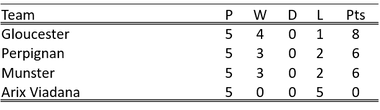
​Going into the final game Pool 2 looked like this. 
Picture
With Perpignan set to face Italian side Arix Viadana, it was accepted that Munster would have to beat the brilliant English side Gloucester to have any chance of progressing. If both of these things happen, all three teams would then end up on 8 points. 

Munster remarkably won the game 33-6, scoring four tries in the process. A winning margin of 27 thanks to Ronan O’Gara’s last second conversion. So too did Perpignan, meaning a three-way tie at the top. Munster's winning margin and method are crucial in the miracle. Here is why.

Before kick-off Munster knew that they would need at least a 27 point winning margin AND four tries to progress. This was a time before bonus points so no extra point was given for scoring four. There are a number of interesting article online that overview the match, and the winning combination needed for this miracle to happen, but none that I could find explained why this was needed. 

I was lucky enough to have a contact to a player that played a starring role for Munster on the day. He admitted to knowing what was needed (27 points winning margin and 4 tries) but not knowing why. With his help and those in Munster Rugby I was guided towards the tie-breaking rules. I could figure out the rest.

So here is why the Munster Miracle was a minimum margin of 27 points and at least 4 tries.
The rules dictated that in the event of a three-way tie like this, the next criteria used to separate the teams would not be points difference but tries scored. And not just tries scored, but tries scored excluding the games against the Italian team. 

Before the final pool game, head to head tries scored read:
 
Tries Scored (Before Last Game)
Perpignan = 10
​Munster = 5
Gloucester = 9
 
With Gloucester on 9, this is why Munster needed at least 4 tries. If Gloucester were to score a try in the game against Munster, the Irish team would have needed 5 tries in that game (total of 10). This of course would have had them level with Perpignan, with the French club stuck on 10.

Munster managed to get 4 tries which got them level with Gloucester, as the English club were held try-less. So, at the end of the final pool game, with all three teams on 8 points, the criteria for tie-breaker (Head-to-Head tries scored) read:
 
Tries Scored (After Last Game)
Perpignan = 10
Munster = 9
Gloucester = 9

As a result, Perpignan topped the Pool and qualified for the knock-out stages. This was not the end for Munster, as they could be one of the two best second placed teams to qualify from the pool stages. This was decided by points difference across all six pools.
 
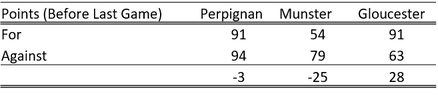
To separate Munster and Gloucester, tie-breaker criteria two was Head-to-Head on points difference, but across all three teams. Before the last Pool game this read:
Picture
With Munster on -25 and Gloucester on +28, the Irish side were 53 worse off going into the last game or -26.5 when you consider a score for Munster is subtracted from Gloucester. This is why there was a need for a 27 winning margin. This then looked afterwards:
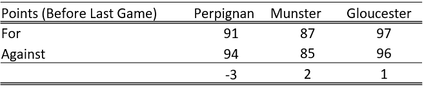
Picture
Munster were +2, and Gloucester +1. In the seconds before Ronan O'Gara's last minute conversion, Munster were 0 and Gloucester +3. That famous kick saw a 4-point swing and was enough for Munster to progress.

Interestingly, Perpignan were -3 and lucky Head-to-Head Tries Scored was the first criteria! In fact, any Munster win with 5 tries would have been enough to secure at least 2nd (even a one point win) so long as Gloucester didn’t score a try.  

Thankfully, the introduction of bonus points in the 2003/4 competition means the complications associated with Munster's "Miracle Match" is unlikely to be repeated. 
<<Previous
Forward>>

    Archives

    October 2026
    September 2026
    August 2026
    July 2026
    June 2026
    May 2026
    April 2026
    March 2026
    February 2026
    January 2026
    December 2025
    November 2025
    October 2025
    September 2025
    August 2025
    July 2025
    June 2025
    May 2025
    April 2025
    March 2025
    February 2025
    January 2025
    December 2024
    November 2024
    October 2024
    September 2024
    August 2024
    July 2024
    June 2024
    May 2024
    April 2024
    March 2024
    February 2024
    January 2024
    December 2023
    November 2023
    October 2023
    September 2023
    August 2023
    July 2023
    June 2023
    May 2023
    April 2023
    March 2023
    February 2023
    January 2023
    December 2022
    November 2022
    October 2022
    September 2022
    August 2022
    July 2022
    June 2022
    May 2022
    April 2022
    March 2022
    February 2022
    January 2022
    December 2021
    November 2021
    October 2021
    September 2021
    August 2021
    July 2021
    June 2021
    May 2021
    April 2021
    March 2021
    February 2021
    January 2021
    December 2020
    November 2020
    October 2020
    September 2020
    August 2020
    July 2020
    June 2020
    May 2020
    April 2020
    March 2020
    February 2020
    January 2020
    December 2019
    November 2019
    October 2019
    September 2019
    August 2019
    June 2019
    May 2019
    April 2019
    March 2019
    February 2019
    January 2019
    December 2018
    November 2018
    October 2018
    September 2018
    August 2018
    July 2018
    June 2018
    May 2018
    April 2018
    March 2018
    February 2018
    January 2018
    December 2017
    November 2017
    October 2017
    September 2017
    August 2017
    July 2017
    June 2017
    May 2017
    April 2017
    March 2017
    February 2017
    January 2017
    December 2016
    November 2016
    October 2016
    September 2016
    August 2016
    July 2016
    June 2016
    May 2016
    April 2016
    March 2016
    February 2016
    January 2016
    December 2015
    November 2015
    October 2015
    September 2015
    August 2015
    July 2015
    June 2015
    May 2015
    April 2015
    March 2015
    February 2015
    January 2015
    December 2014
    November 2014
    October 2014
    September 2014
    August 2014
    July 2014
    June 2014
    May 2014
    April 2014
    March 2014
    February 2014
    January 2014
    December 2013
    November 2013
    October 2013
    September 2013
    August 2013
    July 2013

    About

    This website was founded in July 2013.

    RSS Feed

    Categories

    All
    American Football
    Athletics
    Baseball
    Basketball
    Behavioural Economics
    Boxing
    Broadcasting
    Competitive Balance
    Cricket
    Cycling
    Darts
    David Butler
    Declan Jordan
    Drugs
    Ed Valentine
    Epl
    Esports
    Expenditure
    F1
    Fifa World Cup
    Finances
    Funding
    Gaa
    Gaelic Games
    Gambling
    Game Theory
    Gary Burns
    Geography
    Golf
    Greyhound Racing
    Guest Posts
    Horse Racing
    Impact Studies
    John Considine
    John Eakins
    League Of Ireland
    Location
    Media
    Mls
    Mma
    Olympics
    Participation
    Paul O'Sullivan
    Premier League
    Regulation
    Research
    Robbie Butler
    Rugby
    Simpsonomics
    Snooker
    Soccer
    Spatial Analysis
    Sporting Bodies
    Stephen Brosnan
    Swimming
    Taxation
    Teaching
    Technology
    Tennis
    Transfers
    Uefa
    Ufc
    World Cup
    Wwe

Powered by Create your own unique website with customizable templates.