The Economics of Sport
  • Sports Economics
  • About
  • Workshop
  • Selected Publications
  • Book Reviews
  • A Primer on Gaelic Games
  • Upcoming Events
  • Media
  • Education
  • Resources & Links

Fixing The League Of Ireland

8/10/2020

 
By Robbie Butler,

In the summer of 2017 I was asked to contribute to the Cork City FC match day programme. With University College Cork as the main sponsors of the club it was a nice fit and a chance to engage with the wider community in Cork.

I decided to touch on the general issue of championship uncertainty and the unique place that the League of Ireland holds when it comes to competitive balance. Within the article, which appeared in the match-day programme on the 9th of July 2017, I said the following:

"Often league success has been followed by a period of gradual decline, ending in financial distress and in some cases even relegation. The cycle of champions to relegation could take less than a decade to be complete. This rarely happens in other European leagues where followers will probably know Bayern Munich have just won their fifth consecutive league title, Juventus secured a sixth Seria A title, while Celtic have also been crowned champions for the past six seasons, and finished the current campaign unbeaten."

This may now become all too true for Cork City [again]. It has not taken a decade, but rather three years. The club remains bottom of the Premier Division in Ireland, and while relegation is still very much avoidable, less than 3 years ago the club won a historic league and cup double.

How can you go from double winners to relegation candidates in less than 36 months?

​In few (of any) other European league does a team that wins the domestic double face relegation 3 years afterwards.  And it is not the first time. Why does it happen here?

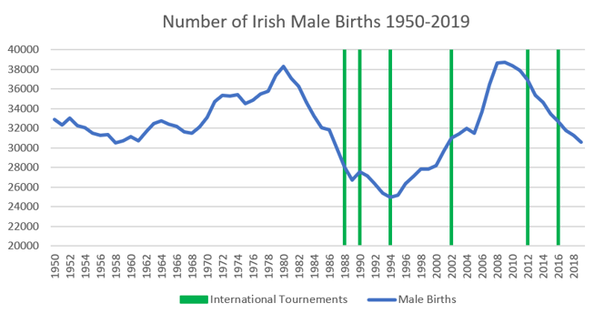
I have previously explored the issue here and here. One of the figures in the links is presented again below. It demonstrates how quickly League of Ireland champions can go into a spiral of decline 1 to 4 years post winning the league. ​Cork City's decline is even more rapid.
Picture
The rate of decline is even more apparent when compared to other European league winners from 2017 - the last time Cork City were champions.

The official UEFA 2017 Roll of Honour lists the league and cup champions that year for each nation member.

Should Cork City be relegated, the League of Ireland will be the only UEFA member where the 2017 league champions are no longer in the top division of their national league. This is an ongoing problem, and on which seems to be uniquely Irish. There is a need for the entire competition structure of the League of Ireland to be changed.

​As I have said previously, the removal of promotion and relegation would be the first positive step in helping what was once infamously called "the problem child" of Irish football.

Radio Broadcasts and Television Rights

25/9/2020

 
By Robbie Butler

In May 2019 Irish national radio station Today FM broadcast its final episode of Premier League Live. The radio station had provided live coverage of a Saturday 3pm kick-off to radio listeners, and no doubt countless others online, for 21 consecutive seasons. I must admit, despite often listening to the show on the radio, I did not become aware of the decision to end the broadcast until the start of the 2019-20 season. 

I was both disappointed and surprised that the show had come to an end. For me, it was something that I habitually listened to on Saturday's and acted as a reference point in both my week and calendar year. As I reflected on the ending of the show in the weeks ahead, my surprise at the decision declined, but my disappointment remained. However, the game has changed over the past 21 years and the decision to end Premier League Live probably reflected this - and all of this before Covid-19. 

When I think of my consumption of the show it primarily occurred while I was in a car. I wonder how many others were in the same position? If I didn't happen to drive on Saturday afternoon, I probably didn't listen. 

A second issue must have been the television schedule that has become more and more important in recent seasons. The 3pm Saturday kick-off is now the home of many of the lesser games during the season. The 'big' fixtures generally take place at lunchtimes on Saturdays, on Sunday afternoons or Monday evenings. I wonder how much demand for listening was impacted by the games taking place.

The arrival of a 3pm game on television - the blackout does not apply in Ireland - was no doubt another blow to the radio show. Sometimes the game on TV was the same as that broadcast on radio. Of course, the televised game was behind the paywall, but could be viewed in most pubs.

And one has to wonder if the show would have survived this season, had it not been cancelled. The continuation of football behind closed doors means almost every game has a different kick-off time. Every game is broadcast on television, making the radio an inferior good. Well for most anyway.

With television today effectively having a match on numerous times a day, every day of the week, radio broadcasts may soon be a thing of the past entirely. 

From Paris To Berlin (And Most Other Western European Capitals)

3/9/2020

 
By Robbie Butler

Just like John in the post before this one, I too watched Stage 5 of the Tour de France. However, unlike John, my motivation was not to watch the cycling but rather the route in southern France that finished in the small town of Privas.

Most people (French people that I have met included) have never heard of Privas. With a population of less than 10,000 people it is easy to understand why. However, the town is a commune of France, and capital of the Ardèche department, the smallest administrative centre of any department in France. The reason I know is Privas is because I was lucky enough to visit the area 5 times during 2010-2013 while completing my PhD. It was fantastic to see the sprint finish into the town, along it's narrow streets, a far cry from the Champs-Élysées where the tour will finish.

And turning to Paris, where the Tour will end on the 20th of September, one can imagine that the Champions League loss is still fresh in the memory of Parisians. The end of the Tour might be a welcome distraction for many. The club's first appearance in the showpiece European game did not work out as expected. And while the champion of the Tour de France will always be crowned in Paris, the Champions League trophy has never been to the French capital.

And Paris is not alone in this regard.

One my second trip to Privas in 2010 I spent the entirety of my TGV journey from Paris Charles de Gaulle to Valence (south of Lyon) reading the wonderful Soccernomics by Kuper and Szymanski. I couldn't put it down. It was one of those rare books that I had to stop myself from reading, so as to have it for just a little longer. One of the earlier chapters recalls the success of club football teams in the European Cup. It is somewhat remarkable how so few clubs from Western capital cities have won the competition. PSG and Paris remain in this list.

The Table below lists the number of times the European Cup/Champions League trophy has been won by capital cities and regional cities in Western Europe. Just two other countries have clubs teams that have won the cup - Romania and the Former Yugoslavia. In both cases the teams were from the capitals (Steaua București (1986) and Red Star Belgrade (1991). Both were under dictatorship communists government at the time of their success. 
And this is what make the list to the left even more interesting. The obvious outlier is Spain. Real Madrid have won a remarkable 13 European titles. Adding in Lisbon (Benfica), the two national capitals on the Iberian peninsula have won 15 European Cups/Champions Leagues. It is worth noting however that both cities had authoritarian governments until the 1970s. Benefica won both titles (1961 and 1962) under this system and Real Madrid their first six. 

Western European capitals that have been fully democratic since 1945 have a pretty dismal record at winning the tournament. Ajax of Amsterdam (if you agree this is the capital and not The Hague) is the only bright spot. In fact, even London with the might of Chelsea, Arsenal and Tottenham had to wait until 2012 to win the competition for the first time. 
Berlin, Edinburgh, Rome and Paris are all devoid of success. This is not to mention Athens, Bern, Brussels, Copenhagen, etc. who will probably never boast the winner. Instead the power lies in the regional cities. Places like Munich, Milan, Liverpool, Manchester, Barcelona and Turin. And historically in cities like Birmingham, Nottingham, Hamburg, Rotterdam, Eindhoven, Glasgow, Porto and Dortmund.

Kuper and Szymanski hypothesize why this might be the case, and why capitals like Paris could emerge as winners in the not too distance future. But for now, Neymar and co. will have to wait. 

Salary Caps And The English Football League

17/8/2020

 
By Robbie Butler

Since football almost everywhere has been forced to play behind closed doors many aspects of the game have come on the radar. One such area of concern has been player salaries. This is acutely true for lower football teams where match-day income, particularly gate receipts, are a main source of income. This income has disappeared and might not return for some time as it is unlikely supporters will be allowed to attend matches in the normal fashion in the near future.

In response to the erosion of many English Football League club's primary source of income, the 2nd, 3rd and 4th tiers of the professional game have proposed the introduction of a salary cap. Such a move is largely unprecedented in recent times (in 1901 the FA introduced a salary cap that would remain until 1963) and would mark a power shift, back towards club owners. This would break the trend of the past 50+ years where players have become more and more powerful. 

Salary caps are not unusual in other sports around the world. North American sports employ salary caps quite effectively. All of the major sports in the US, with the exception of Major League Baseball (MLB) use salary caps. MLB instead uses a luxury tax.

In theory, there are two main benefits derived from salary caps. The first is that it brings greater parity between teams or competitive balance. The second is that is encourages teams to live within their means and avoids costs spiraling out of control.

Of course, not everyone is happy. The Professional Footballers' Association (PFA) - the players union - have voiced their concern. Formed on 2nd December 1907, the PFA is in its own words "the world’s longest established professional sportsperson’s union".

The union has come a long way since the "retain and transfer" system which effectively tied players to clubs, not unlike baseball's reserve clause.  For example, in 1959, George Eastham refused to sign a new contract with his club, Newcastle United, and requested a transfer. This request was declined. The source of the problem was Eastham disputing whether the house the club had supplied him was habitable and the unsatisfactory secondary job that the club had arranged. Eastham refused to play for Newcastle United in the 1960-61 season. Unable to leave, the player went on strike in early 1960. However, in October 1960, Newcastle United finally agreed to transfer the player to Arsenal for £47,500. 

As Eastham later recounted:
 “Our contract could bind us to a club for life. Most people called it   the "slavery contract". We had virtually no rights at all. It was often the case that the guy on the terrace not only earned more than us – though there's nothing wrong with that – he had more freedom of movement than us. People in business or teaching were able to hand in their notice and move on. We weren't. That was wrong”. Rebels for the Cause (2004).

Backed by the PFA, Eastham brought proceedings against Newcastle United in the High Court. In the case, Eastham v. Newcastle United [1964] Ch. 413, the judge ruled partly in Eastham's favour and the retain and transfer system was never the same again. 

It will be interesting to see how the hard fought gains since 1963, which culminated in the European Bosman Ruling in 1995, will be impacted by any such salary cap. Might we be moving back in the direction of the owners?

Bankruptcy And The English Football League

27/5/2020

 
Picture
By Robbie Butler

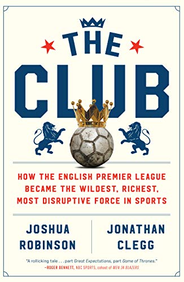
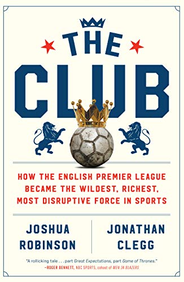
The Club by Joshua Robinson and Jonathan Clegg is an excellent overview of the rise of the English Premier League told through fascinating stories of those of involved. There is a book review on this site if anyone wants to know more. Gary Neville's recent comments about how English Football League clubs are in grave financial peril got me thinking about one of the stories in the book.

According to Neville the top tier clubs in the Premier League, and not the British Government, should bail out clubs in the lower leagues that face bankruptcy. MP Damian Collins claims this could be 10 clubs in the coming days. Huddersfield Town owner Phil Hodgkinson is far more pessimistic and told the BBC “50 or 60” ELP clubs could be forced out of the game if stadiums are empty when football returns.

The story in The Club that this reminded me of was a meeting of US-based Premier League owners in the early 2010s. I think the book recalls a meeting in a classy New York restaurant which included representatives of the Glazers, FSG and Stan Kroenke. (The book remains locked in my office so I cannot check as I still don't have access).

As the story goes, the owners of bitter rivals Man Utd, Liverpool and Arsenal met to discuss their investments. In years gone by it would have been unheard of for such a meeting to take place with local owners. But the Premier League had changed.

The US ownership model is very different. While owners compete on the pitch, they are committed to cooperating off it. In this sense sports economics is almost unique as it requires competition and cooperation. One of the topics up for discussion at the meeting? Relegation.

For many in the US this is a strange concept. It does not exist in the major leagues. Franchises that finish bottom or near the bottom are not punished by demotion to a lower league. In the Premier League, and other major football leagues, this is the ultimate punishment. For American owners, this is far from ideal. If they could, they would probably undo the 150+ year tradition of promotion and relegation, to ensure their team could never leave the paradise and riches that is the Premier League. The value of their investment would soar.

Unfortunately for them, 72 other clubs in the Football League and hundreds of others in the non-leagues would never allow this to happen. Relegation will remain. The negative consequences of this for team owners each year are there for all to see. Just ask American Ellis Short, the one-time owner of Sunderland, who endured a double relegation before selling the club. The Nextflix series Sunderland Till I Die captures the story.

So when Gary Neville calls for the Premier League clubs to rescue those in the lower leagues, I wonder about the motivations of either side. Neville is a co-owner himself of 4th tier Salford City. Naturally, he would like to see investment flowing from the top tier to the lower leagues.

But if Huddersfield Town owner Phil Hodgkinson is right, and 92 clubs were to become 42 or even fewer, this would dramatically alter the competition structure. Imagine if just 30 clubs survived. Could relegation be scrapped? Could two equal conferences emerge with a play-off system. Sounds familiar. It's the MLS and other major sports leagues in the US.

If only the Premier League survived, the owners of each club would see the value of their assets soar. Relegation would be no more. Just guaranteed top flight income and revenues indefinitely.

Transfer Fees And Market "Corrections"

26/4/2020

 
By Robbie Butler

Under any criteria, the rise in the economic value of football in my lifetime has been remarkable. Two of the most obvious examples of this can be the found in transfer fees and broadcasting revenue.

In 1982, one of the greatest players of all time, Diego Maradona, left his native Argentina and signed for Barcelona. The cost of the transfer fee - just £3 million. That was almost 40 years ago. What about inflation? This must be a £100 million today, no?

Using UK data, and pound sterling fees (the euro was only created in 1999), Diego Maradona's real fee today is just £10.65 million. Just £10.65 million! In the most recent transfer window, Championship side Fulham signed Portuguese winger Ivan Cavaleiro for about the same real price as Maradona.

The rise in the real cost of footballers has been truly astonishing over the past 40 years. Data on this, considering each time the nominal record fee was broken, is presented below. As I pointed out in a post a number of years ago, on three occasions the nominal record was broken, but the real fee remained below the record price. 
Picture
The real increase in transfer fees is remarkable when compared to the 1982 Maradona fee which Barcelona paid to Boca Juniors. For example, by 1992 one Gianluigi Lentini of AC Milan was worth roughly 2.5 Maradona's. I doubt there is a football fan anywhere, ever, that could make a case for this. The Italian was good but a shadow of the player the great Argentine was. 

Zinedine Zidane and Kaka are the equivalent of 7 Diego's. Gareth Bale and Paul Pogba are today worth 9 Mardona's, Cristiano Ronaldo is worth 10. Neymar almost 20. That's an entire squad of players.

What funded this extravagant increases can be found in the far right columns - broadcasting fees. My data is only for English top flight football but is a reasonably good comparison. In 1982 Maradona's fee was worth more than the entire 1st Division broadcasting agreement between the FA, BBC and ITV. 

The ratio between this and subsequent agreements makes the increase in the real cost of transfers seem small. It is astonishing growth. Today, the Premier League broadcasting rights are worth more than 200 times what they were when Maradona left Buenos Aires in 1982. And this is in real terms! It is what largely continues to fuel transfer fees and salary increases.

Will Covid-19 lead to a transfer fee correction? There are many factors at play, but it is possible.

To what extent, will depend on changes in the broadcasting fees paid by providers and the impact of the crisis on the wealth level of rich owners. Any correction may also be a short run effect. If broadcasting fees are unaffected, 'normal' service will likely resume sooner rather than later.

Scottish Leagues End But The Battle Is Only Starting

16/4/2020

 
By Robbie Butler

This post builds on the two most recent on the site. Again, promotion and relegation is the central issue. It is this that is, and will continue, to pose the greatest level of difficulty for sports administrators in the wake of Covid-19.

Earlier this week I argued that leagues would be better off finishing 2019/20 before attempting to start 2020/21, whenever that may be. Those in Scotland think otherwise.

The Scottish Professional Football League (SPFL) has now voted to end a number of domestic leagues. This decision covers the 2nd, 3rd and 4th tiers of Scottish football and means various clubs will be promoted and relegated based on current league position, even though the seasons were all cut short.

Enter Heart of Midlothian (Hearts). The Edinburgh club are currently bottom of the Scottish Premiership. While the  SPFL decision is not currently in place for the Premiership (1st tier), Hearts must fear it will be extended in time if things do not improve in the UK. A ready-made replacement is now waiting in the wings. Dundee United have now been promoted from the 2nd tier following the decision to end the season and will expect a place in the Premiership in 2020/21.

Fearing that Hearts will be the one to drop out, Hearts owner Ann Budge has said:
"I have said from the outset that it was imperative that we find a solution that ensures no club is penalised by relegation in a situation where the leagues cannot be finished. The financial consequences are enormous."

It is hard not to have sympathy with Budge. However, the sentence also holds for the soon-to-be promoted Dundee United. The financial consequences of not being promoted are enormous. 

Something has to give. I get the feeling sports lawyers in Scotland are going to be extra busy very soon!

Major League Soccer 2020

20/1/2020

 
By Robbie Butler

The 25th season of Major League Soccer will kick-off at the end of next month and will include David Beckham's new franchise Inter Miami CF and Tennessee franchise Nashville SC. This will bring the total number of teams to 26 – the highest to date.

Inter Miami will form part of the Eastern Conference, while Nashville SC will join the Western Conference. This, despite the fact that the Nissan Stadium, home of Nashville, is more easterly than Soldier Field, the home of Chicago Fire who play in the Eastern Conference. The arrival of the new franchises, and the division they play in, got me thinking about the distances these teams must travel weekly in order to fulfill fixtures.

I recall Steven Gerrard’s time with LA Galaxy and comments by the former Liverpool player that the travel involved playing MLS was exhausting. This is especially true when one compares it to the Premier League in England.

In early January, Liverpool played Everton in an FA Cup 3rd round game. During a stoppage in play, a drone above the stadium moved slightly northwards, and Everton’s Goodison Park came into view. There is less than 1 mile between the two stadiums. For newly recruited players of Inter Miami, their 'derby match' with Orlando City SC will require a 205-mile journey north. This is just shy of Liverpool visiting a London club, which is hardly a derby.

The distances a franchise will travel in the MLS arequite something. In this post I considered only the Eastern Conference. The Western Conference would appear far worse. New players for Inter Miami have some serious travel ahead, given Miami’s location. After Orlando, the next closest venue is the 580-mile trip to the magnificent Mercedes Benz Stadium in Atlanta, a round trip of nearly 1,200 miles. This is like Liverpool heading to Cologne in Germany.

Inter Miami players will have at least seven trips in the Eastern conference that exceed 1,000 miles one way! The longest being the 1387-mile distance to play Montreal Impact – the greatest distance between two franchises in the Eastern Conference. Liverpool to Rome is almost the exact same distance.

Considering all franchises for the conference, there is probably just one derby, by European standards that is. The 20 miles separating the Yankee Stadium from the Red Bull Arena in New Jersey, homes of the New York City and New York Red Bulls.

Travel distances can be found to have significant impact on performance. I will consider the impact this has on match outcomes in the MLS in a future post. For new recruits of Inter Miami, they better be ready to travel. Although, Nashville SC will make this look short. More to follow on this. 

Going To Qatar Rather Than Birmingham

20/12/2019

 
By Robbie Butler

Casual fans of football might have been surprised to see a score line from the Quarter Final of the Carabao (league) Cup that read Aston Villa 5 - 0 Liverpool. The recently promoted team beat the European Champions comfortably to book their place in the last 4.

What the score line doesn't tell you is that the average age of the Liverpool team was a little over 19. Probably more discrete, but equally telling, is that the sum of the squad numbers for Liverpool was just short of 1,300! That's an average of 72. The lowest number on the back of any Liverpool jersey at Villa Park was the "51" visible on the back of Ki-Jana Hoever. 

While the youngsters were battling against Villa the Liverpool first team was busy preparing in Qatar for the FIFA World Club Championship Semi-Final. Unfortunately for the Merseyside club, fixture congestion meant that the only way the club could compete in both competitions was to hold games within 24 hours of one another. 

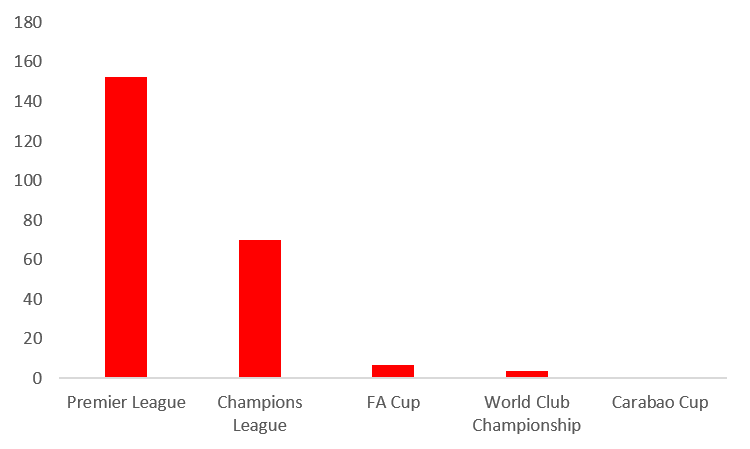
There are many reasons why the club decided to priorities a trip to Qatar over Birmingham but probably the most obvious is the chasm in prizemoney available in both. The figures below provide sources of prizemoney for the 2019/20 season. Data for the Premier League is taken from 2018/1 as the variability in winnings are based on the number of appearances on television, as well as finishing position. 
Picture
Picture
On the left, all competitions that Liverpool will compete in are presented. The Premier League was the source of more than £150 million pounds in prize money last season. In 2019/20 success in the Champions League again would results in a windfall of around £70 million. The FA Cup could be worth almost £7 million in prizemoney.

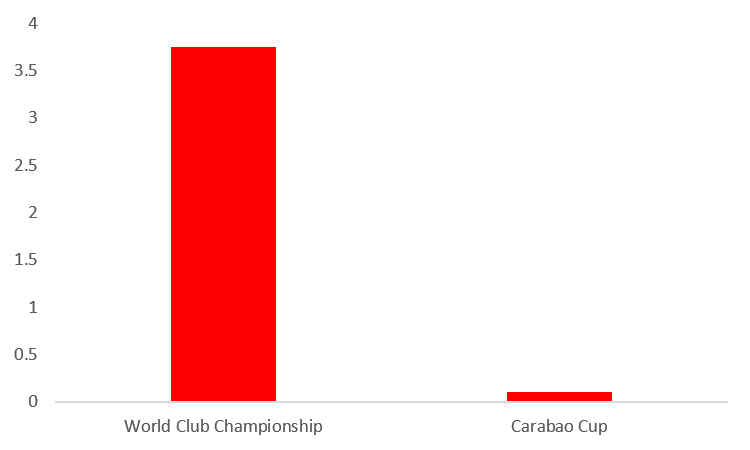
While the FIFA World Club Championship is worth about half of the FA Cup (£3.75 million) it involves just two games. In fact, just showing up is worth in Qatar is worth £1.5 million to the Red. 

Compare this to winning the Carabao Cup. The figure to the right, takes a closer look at the FIFA World Club Championship and Carabao Cup, as the latter is too small to see on the left-hand graphic. At just £100,000 for the winners it is easy to see why Liverpool chose to head to the sun this week. 

Premier League Jobs and Name Changes

27/11/2019

 
By Robbie Butler

Earlier this week, former England manager Sam Allardyce said on TalkSport radio:

"The best way to get a Premier League job if you are British is to change your name to a foreign name. I have always said if I was ‘Allardicio’ I could have managed Manchester United". (The interview can be seen here).

This is quite a statement given that Allardyce, who began his managerial career in Ireland taking charge of Limerick, is the only person ever to manage 7 Premier League clubs over some 512 games (Bolton Wanderers (226), West Ham United (114), Blackburn Rovers (76), Sunderland (30), Everton (24), Newcastle United (21), Crystal Palace (21)). 

10 of the top 12 managers, listed by the number of Premier League games they have managed, are from Great Britain or Northern Ireland. This includes Sam himself, Alex Ferguson, Harry Redknapp, David Moyes, , Mark Hughes, Steve Bruce, Martin O'Neill, Alan Curbishley, Tony Pulis and Alan Pardew.

The overall distribution of managers by nationality is also skewed towards domestic (U.K) managers. In total 204 men have been appointed to 399 positions. The distribution by nationality is presented below.  
Picture
At present in the Premier League almost half of the managers are from Great Britain or Northern Ireland. While this is a drop in domestic representation when compared with the overall data from 1992, it is hard to argue that British managers are not well represented in the top league.

Of course, a different argument is that home-grown managers are not given the "top" jobs but this is a different argument entirely.

​The biggest job of them all, the England national team job, has been held by four English men since Italian Fabio Capello left the post in 2012. Alex Ferguson, David Moyes, Roy Hodgson, Kenny Dalglish, Tim Sherwood and Frank Lampard all manage(d) at top clubs during this decade.

As a starting point, the best way to get a job in the Premier League today is probably to be a very good manager.

<<Previous
Forward>>

    Archives

    October 2025
    September 2025
    August 2025
    July 2025
    June 2025
    May 2025
    April 2025
    March 2025
    February 2025
    January 2025
    December 2024
    November 2024
    October 2024
    September 2024
    August 2024
    July 2024
    June 2024
    May 2024
    April 2024
    March 2024
    February 2024
    January 2024
    December 2023
    November 2023
    October 2023
    September 2023
    August 2023
    July 2023
    June 2023
    May 2023
    April 2023
    March 2023
    February 2023
    January 2023
    December 2022
    November 2022
    October 2022
    September 2022
    August 2022
    July 2022
    June 2022
    May 2022
    April 2022
    March 2022
    February 2022
    January 2022
    December 2021
    November 2021
    October 2021
    September 2021
    August 2021
    July 2021
    June 2021
    May 2021
    April 2021
    March 2021
    February 2021
    January 2021
    December 2020
    November 2020
    October 2020
    September 2020
    August 2020
    July 2020
    June 2020
    May 2020
    April 2020
    March 2020
    February 2020
    January 2020
    December 2019
    November 2019
    October 2019
    September 2019
    August 2019
    June 2019
    May 2019
    April 2019
    March 2019
    February 2019
    January 2019
    December 2018
    November 2018
    October 2018
    September 2018
    August 2018
    July 2018
    June 2018
    May 2018
    April 2018
    March 2018
    February 2018
    January 2018
    December 2017
    November 2017
    October 2017
    September 2017
    August 2017
    July 2017
    June 2017
    May 2017
    April 2017
    March 2017
    February 2017
    January 2017
    December 2016
    November 2016
    October 2016
    September 2016
    August 2016
    July 2016
    June 2016
    May 2016
    April 2016
    March 2016
    February 2016
    January 2016
    December 2015
    November 2015
    October 2015
    September 2015
    August 2015
    July 2015
    June 2015
    May 2015
    April 2015
    March 2015
    February 2015
    January 2015
    December 2014
    November 2014
    October 2014
    September 2014
    August 2014
    July 2014
    June 2014
    May 2014
    April 2014
    March 2014
    February 2014
    January 2014
    December 2013
    November 2013
    October 2013
    September 2013
    August 2013
    July 2013

    About

    This website was founded in July 2013.

    RSS Feed

    Categories

    All
    American Football
    Athletics
    Baseball
    Basketball
    Behavioural Economics
    Boxing
    Broadcasting
    Competitive Balance
    Cricket
    Cycling
    Darts
    David Butler
    Declan Jordan
    Drugs
    Ed Valentine
    Epl
    Esports
    Expenditure
    F1
    Fifa World Cup
    Finances
    Funding
    Gaa
    Gaelic Games
    Gambling
    Game Theory
    Gary Burns
    Geography
    Golf
    Greyhound Racing
    Guest Posts
    Horse Racing
    Impact Studies
    John Considine
    John Eakins
    League Of Ireland
    Location
    Media
    Mls
    Mma
    Olympics
    Participation
    Paul O'Sullivan
    Premier League
    Regulation
    Research
    Robbie Butler
    Rugby
    Simpsonomics
    Snooker
    Soccer
    Spatial Analysis
    Sporting Bodies
    Stephen Brosnan
    Swimming
    Taxation
    Teaching
    Technology
    Tennis
    Transfers
    Uefa
    Ufc
    World Cup
    Wwe

Powered by Create your own unique website with customizable templates.