The Economics of Sport
  • Sports Economics
  • About
  • Workshop
  • Selected Publications
  • Book Reviews
  • A Primer on Gaelic Games
  • Upcoming Events
  • Media
  • Education
  • Resources & Links

Playing Sport & Studying Economics

18/4/2015

 
By David Butler

I remember reading Socrates
obituary in the Economist Newspaper when he passed away in 2011. He lived an amazing life. Above all else, he was an intelligent man, earning a degree in medicine while playing professional football.

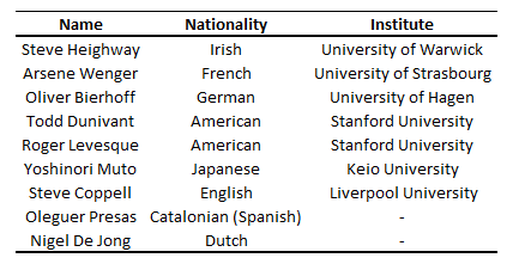
Two weeks ago the media claimed that Chelsea had made a £4m bid for FC Tokyo and Japan international striker, Yoshinori Muto.  The interesting thing for me was that the 22 year old has just finished a degree in Economics in the Keio University. This got me thinking about how many professional athletes followed in Socrates ways. For the purpose of this website-which stars have studied Economics?

A quick online search listed plenty of American athletes from American Football, Baseball and Basketball that studied the discipline. These included  names such as John Elway (Stanford), Merlin Olson (Utah State), Mike Mussina (Stanford) and Jeremy Lin (Harvard). The most high profile name was Tiger Woods (Stanford). Given the prestige of college sports in America there was far more elite performers that studied Economics. 
From an Irish perspective many of our recent international Rugby players have studied Economics. These include Ronan O Gara (UCC), Rob Kearney (UCD) and Gordon D'arcy (UCD).

Below is a list of famous names from soccer I found online that studied or majored in Economics. Hopefully I haven't missed anyone - unfortunately, I couldn't locate the institutions for Oleguer and De Jong .
Picture

Research Seminar - University College Cork

17/4/2015

 
Professor Bill Gerrard (Business and Sports Analytics Unit at Leeds University Business School) will be presenting in Room AL2.15 (Aras na Laoi) at 12 noon on Wednesday 22nd of April 2015.

This presentation is titled “From Analysis to Analytics: An Action Case Study of Evidence-Based Practice in Elite Team Sports”.

Professor Gerrard has worked with a number of elite sports teams around the world. He currently acts as technical analyst for Saracens in the Aviva Premiership (rugby union) as well as providing statistical analysis to support Sky Sports coverage of Super League (rugby league). He has worked with Billy Beane, the General Manager of the Oakland Athletics in Major League Baseball, whose application of sports analytics has been the subject of the Hollywood film and best-selling book, Moneyball. Professor Gerrard is also on the Editorial Board of the Journal of Sports Economics. 

Property Rights and Sport: An Interesting Week

17/4/2015

 
By John Considine
The last couple of days have raised issues that are central to the economics of sport in Ireland.  They also illustrate issues that are central to economics as a discipline and to the organisation of sport.  Specifically, the issues involved concern the property rights generated by sport.

Yesterday it was announced that the government are to give €900,000 in grants to inter-county GAA players.  Yet, the GAA is wedded to the amateur principle that is interpreted as players should not be paid for playing.  The government money is indirectly, rather than directly, for playing because to be eligible one has to be a player.  This is not to suggest for one moment that the government is undermining the principle against the wishes of the GAA.  The GAA welcomed the government announcement.  Borrowing, and slightly abusing a term from US college sports, the Irish government is a GAA booster.

As an individual, my sympathies lie with the principle of amateurism for gaelic games.  As an economist, I realise that the case for amateurism is far from overwhelming.  Should a player be paid for doing something for which a sports organisation charges patrons?  Who SHOULD hold the property right?  Rather than reinforce the views of those whose sympathies, like myself, lie with amateurism, I would encourage them to read Leonard Koppett's essay "The Poison of Amateurism".  You may not have a change of heart but you could have a change of mind.

Whereas the amateurism issue is about the distribution of rewards within a sports organisation, the issue of broadcasting rights can be about the distribution of rewards a sports organisation receives.  Two days ago, speaking at the launch of the ISC Youth Field Sports grants, the IRFU's Philip Browne addressed this very issue (here and here).  Browne welcomed the government funding for grassroots rugby but warned against the government interfering in the market for broadcast rights.  However, European policy makers do not see public goods in exactly the same way economists see them.  The European Television Without Frontiers directive allows the government of each member state to list sporting and cultural events that must effectively be shown on free-to-air TV.  The IRFU might argue that the property rights on broadcasting should entitle them to do as they wish with their right.  However, the EU takes a broader view of these things.  Microsoft made a similar argument when they claimed that the code for their operating system was theirs to do with as they wished.  If they wished to exclude the writers of applications from access to the code then Microsoft felt that was their business.  The EU disagreed and forced Microsoft to provide access to the code.  It is noteworthy that the US antitrust authorities did not go as far as their EU counterparts.

So, who should hold the property rights?  Should it differ between sporting organisations?  Why is there differences of opinions between economists and lawmakers on the issues?  The answers to these questions can very much depend on one's perspective.

England Selection

16/4/2015

 
By Stephen Brosnan

In a previous post, which can be found here, I discussed whether England’s strikers were selected based on form or reputation. While discussing the findings I noticed that all of the strikers selected by Roy Hodgson for the upcoming Euro qualifiers were on the books at Champions League chasing clubs. This got me wondering about the significance of a players club when being selected for international duty and specifically whether playing for clubs lower down the Premier League table hampers a players chances of selection for internationals.

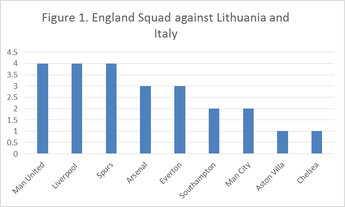
Data from fantasypremierleague.com has been utilised to compare the number of players selected from each club by Roy Hodgson against the best performing players in Fantasy Premier League over the course of the season. Figure 1 shows the number of players selected from each club by England for the qualifier against Lithuania and friendly versus Italy. Three clubs have four players in the current England squad, Manchester united, Liverpool and Tottenham Hotspurs followed by Arsenal and Everton with three players each in the squad. Before the injury to Fraser Forster Southampton had two representatives along with Manchester City. Aston Villa and Chelsea make up the rest of the clubs represented with one player from each team included. Out of the nine teams which are represented in the England squad, eight finished in the top eight in the Premier League last season with only Aston Villa finishing outside the Premier Leagues top 10. 
Picture
Picture
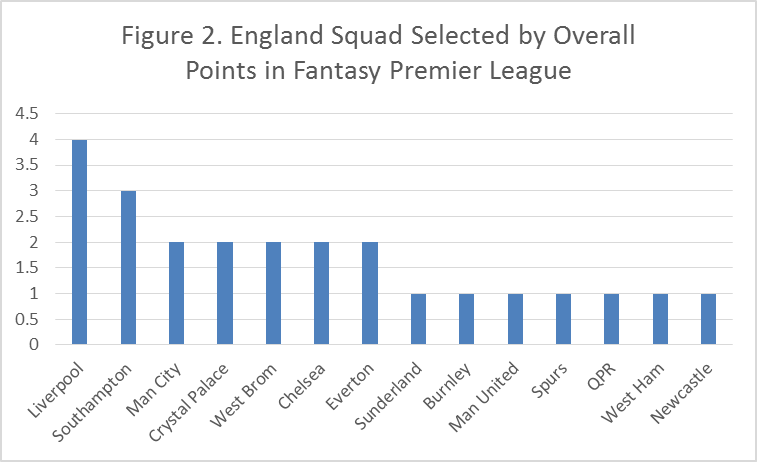
According to players overall points, Liverpool are still the most represented team in the England squad with 4 representatives. Manchester United and Spurs both fall from four representatives in the current squad to just one based on overall points, with Wayne Rooney and Harry Kane scoring enough points for inclusion. Overall, 14 clubs are represented in Figure 2, five more than in the actual England squad.

When players are selected by overall points throughout the season players from clubs down the lower end of the table emerge as optimum picks. West Brom and Crystal Palace who do not have any players featuring in the current England squad each have two players included when the squad is selected according to overall points with Saido Berinho, Jolean Lescott, Scott Dann and Jason Puncheon all performing better than other English players in the same positions. Players from clubs such as QPR (Charlie Austin), Burnley (Kieron Trippier), West Ham (Stuart Downing) and Newcastle (Jack Colbeck) are also included when the squad is selected according to players overall points.

None of Arsenal’s three inclusions in the England squad (Theo Walcott, Kieron Gibbs, Danny Welbeck) would be included in a squad based on overall score while Manchester United’s Phil Jones, Chris Smalling and Michael Carrick also miss out.

It is evident that the England is squad is made up of players playing for the top teams in England. According to the data, players plying their trade outside of the Premier Leagues top clubs may find it very difficult to break into the England squad. The question remains whether Jolean Lescott would still be in the squad had he stayed sitting on Manchester City’s bench or whether Theo Walcott would still be an England regular if he had been sitting on Crystal Palace’s bench as opposed to Arsenal’s. It seems likely that the fastest way for young, up and coming English players, such as Danny Ings and Saido Berinho, to break into the England squad may be to hand in a transfer request and hope the Premier Leagues big boys come calling rather than putting the head down and improving their performances at their current clubs.

Stephan Brosnan is a research assistant working in the Department of Economics at University College Cork.

The League of Ireland: The Most Complex League in the World?

15/4/2015

 
By David Butler

In 2007 the League of Ireland (SSE Airtricity League) merged with the Football Association of Ireland (FAI).  This partnership is due to continue until the end of 2016. In March, the FAI announced that a 
consultation process will take place to get the views of all the key stakeholders in the league and to discuss ways to progress our domestic game. This process is headed by Declan Conroy who is quoted as saying that "we are seeking to understand how we can get more people to our matches every weekend".

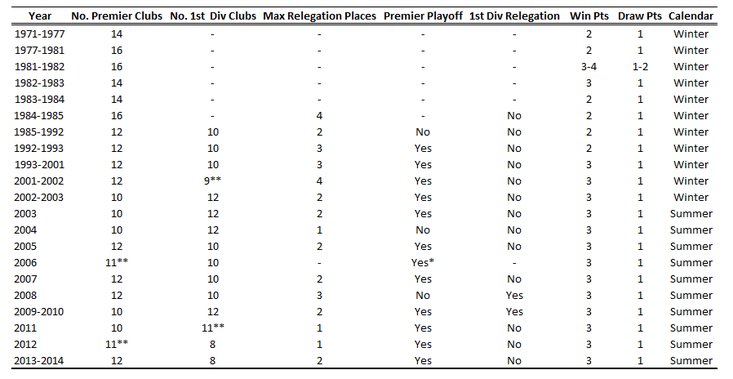
I think all League of Ireland fans would agree with Declan Conroy's sentiment. The problem, as I see it, is that many attempts have already been made to get more fans through the turnstiles and improve our game. To say the League of Ireland structure has been tumultuous over the years would be understatement. The table below shows the League of Ireland structure, points system and fixture calendar from 1971 to 2014.

Over approximately 45 years the League of Ireland has witnessed two point-system experiments (1981-1983), breaking the Premier Division in two to have a top and bottom six (1993-1995), new divisions (1985,2008), play-off systems inaugurated and tweaked (1992), changes to the amount of fixtures played per season and a shift to Summer Soccer (2003). The majority of these rule changes were intended to change the incentives clubs faced and encourage an attacking philosophy.

Let’s hope this consultation process goes well - looking at the recent history, I think it's fair to say the domestic league needs stability. Previously, Declan Jordan forwarded a thought provoking proposal to radically transform 
the League of Ireland.
Picture
The Most Complex League in the World?

*For the 2007 LoI season an Independent Assessment Group established by the Football Association of Ireland determined which clubs would enter the Premier League and First Division. Although there was a playoff in the 2006 season, which Dundalk F.C won, the club was not selected to enter the 2007 Premier League. Thus, despite the play-off occurring in 2006, the result had no bearing on the teams  in the Premier Division for subsequent year.

**Years where an odd number of teams competed in the LoI meant that a team did not complete the season after they were accepted to enter.  In 2001-2002 St. Francis withdrew from the first division before the start of the season. In 2006 Dublin City disbanded during the season for financial reasons and there results were erased. In 2011 Drogheda United were reinstated to the Premier League, despite that they were relegated the previous year, as Sporting Fingal withdrew from the League in February 2010.  In June 2012 Monaghan United withdrew and their results were erased. As was the case with Dublin City, the withdrawal was associated with financial difficulties. These represent unique cases as previously teams that withdrew before the start of the season may have been replaced, as was the case for the 1996-1997 first division that saw St.James Gate F.C replaced by St. Francis F.C before the league commenced.


The Five Day Penalty Kick

14/4/2015

 
By Robbie Butler

Chapter 6 of Kuper and Syzmanski’s wonderful So
ccernomics provides a great insight into the penalty kick. Entitled The Economist’s Fear of the Penalty Kick, the authors' relay a wonderful story from Argentina called the “Longest Penalty Kick Ever”. 

A game in Argentina was abandoned with moments to go when a player, upset that his team had conceded a penalty, decided to punch the referee. The league’s governing body ordered that the remaining time in the game (less than half a minute) be played the following weekend. The kicker and goalkeeper therefore had nearly a week to think about an upcoming penalty kick. In the days prior to the penalty, Kuper and Syzmanski’s write that the goalkeeper facing the kick had the following conversation with the club president and a third party: 

Goalkeeper: “Constante kicks to the right.”
President: “Always”. 
Goalkeeper: “But he’s knows that I know.”
President: “Then were f****d”. 
Goalkeeper: “Yeah, but I know that he knows.”
Third Party: “Then dive to the left and be ready”. 
Goalkeeper: “No. He knows that I know that he knows.”

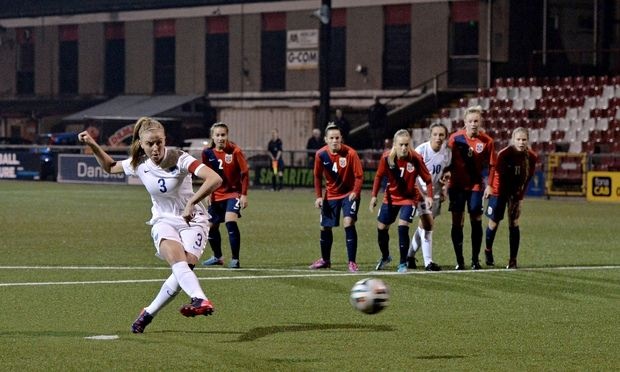
Last week, German referee Marija Kurtes provided us with an almost identical example. During a European Under-19 Championship game between England and Norway, Kurtes disallowed England defender Leah Williamson's goal from the penalty spot due to encroachment by England players. Instead of allowing the penalty to be retaken (the correct decision), the referee awarded a free-kick to Norway. 

The Football Association (of England) appealed the result and the UEFA Control, Ethics and Disciplinary Body ordered the remaining three minutes of injury time should be replayed with both teams as they were before the penalty was taken. Interestingly, to overcome the problems mentioned in the story from Argentina, England were permitted to change their kicker if they so wished. 

So a penalty that was taken on a Saturday would be retaken five days later on Thursday night.
Picture
Arsenal and England's Leah Williamson Penalty Kick - Take Two
To be fair to Williamson, she stood up again. Same side, same result.  The England international told BBC Sport afterward "I went for a sleep. There was nothing else to do. I was pacing around last night, so I didn't want to do that again". 

Nerves of steel. 

Something Old and Something New

13/4/2015

 
By John Considine
Last Saturday, West Bromwich Albion (WBA) hosted Leicester City in the Barclays Premier League.  There were two interesting features of the match day events.  One was a throwback to an earlier time.  The other was an illustration of the way technology is playing a role in the game.

At the game, WBA honoured the memory of their legendary striker Jeff Astle by wearing a replica strip from their 1968 FA Cup win.  Astle scored the winning goal with a header.  He died in 2002 after suffering from a brain condition (
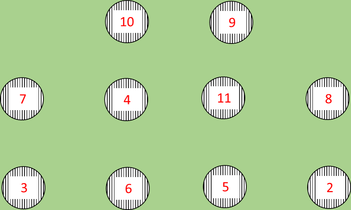
chronic traumatic encephalopathy) more commonly associated with boxers and more recently with American football players.  One of the interesting aspects of the replica kit was the numbers the players wore on their shirts.  The outfield players wore numbers 2 to 11 and the goalkeeper's shirt did not carry a number.

I previously wrote about the role of numbers on shirts in team sports (
here).  At the time I asked about ten people to give me the numbers they would allocated to the positions if they were putting out a team.  Most of those I asked gave me the team numbers for both 4-4-2 and 4-3-3 formations.  None matched the 4-4-2 numbers that WBA used on Saturday.  According to the BBC's Match-of-the-Day programme, WBA played as shown in the graphic below.  The major difference between the graphic and my survey was that my "experts" had 8 in the middle on midfield and 11 on the side.  There was also a divide on whether the centre-halves should wear 4 & 5 or 5 & 6.

One of the reasons players now get assigned a particular number is an economic one.  Namely it allows those purchasing replica kids to identify with a particular player (see some previous posts on shirtonomics by David Butler
here and here).
Picture
While the use of numbers 2 to 11 was a throwback to a previous era, there was another feature of the game that illustrated the operation of technology in the modern game.  In the 8th minute, Darren Fletcher headed the ball towards the goal.  Initially there was some confusion as to whether, or not, the ball had crossed the Leicester City goal line.  Then came a signal from Martin Atkinson that illustrates exactly the difference between the score detection system used in soccer versus the video referee used in rugby.  Atkinson pointed to a watch-like device on his hand to signal that a goal was scored.  Using a number of camera angles, the technology had determined if the ball had fully crossed the plane of the goal line.  The result was transmitted to Atkinson's wrist and the referee signalled the goal.  There was no video referee pouring over footage from various angles to adjudicated on a question posed by the match referee.

Tottenham Hotspur vs. Archway Sheet Metal Works Ltd

11/4/2015

 
By David Butler

Some weeks back it was announced that Tottenham Hotspur Football Club were free to build a new stadium after Archway Steel, a local business, dropped its legal challenge against the club.  The sheet metal manufacturing firm has been in an on-running legal dispute over the redevelopment plans at White Hart Lane. Recently the High Court in England rejected a challenge by Archway Steel over a compulsory land purchase granted to Tottenham. Archway Steel then dropped its legal action and entered negotiations with Tottenham.  On the 31st of March Tottenham reached a private deal with Archway Steel.

This is interesting in light of the Coase Theorem. In his famous 1960 article, The Problem of Social Cost, Chicago Economist Ronald Coase provided us with a means to understand an interaction like this.  While Coase is credited with this theorem, he didn’t name it and it is not really a theorem per se. The idea can be traced to Adam Smith and a standard bargaining solution in Economics was formalised by John Nash in 1950. In a nutshell what Coase did was make the crucial connection between institutions, transaction costs, and neoclassical theory.

Coase implied that if there was well defined property rights between two parties, such as Tottenham and Archway Steel, and that both could bargain without cost, then the private market would solve the problem. Even though an externality exists (Tottenham imposing costs on a private business) both parties have a shared interest in finding a solution.


The first half of Coase’s 1960 paper suggests that in these incidents resources will be allocated efficiently if negotiations take place, meaning that they cannot be rearranged in another way to make anybody better off while not harming others. He implied that this will happen regardless which side the law is on. Simply put, everyone has their price – Tottenham can pay Archway Steel to keep quiet or Archway Steel can pay to Tottenham to halt their plans. The structure of the law only determines the division of the value. If we take all of our standard assumptions regarding how individuals make choices and how markets operate, bargaining can actually solve the problems - no third party is required.  

Of course, Coase then went on to show the essential irrelevance of his argument given that markets are not frictionless and transaction costs associated with bargaining are pervasive.  As Professor Steven Medema, an expert in the work of Ronald Coase puts it, the theorem is a ‘logical fiction’ - it is purely intuitive, not amenable to mathematical proof but is logically sound.


Our initial reaction to the Tottenham vs. Archway case is often to look toward the law to see who has the rights. Cases such as this can often be framed as the 'poor little guy'. Thinking about the problem through the Coase theorem gives us an alternative way to reason and shows us how externalities are reciprocal – if Tottenham were prevented from building their new stadium, their utility sure would be diminished too.

Usually the Coase theorem allows us think about world that doesn't exist but in the Tottenham vs Archway case we have a neat real life event to think about the theorem (that's pretty similar to the examples used in the textbooks). For more of this on a similar theme, John Considine recently spoke about  the Chicago School of Economics and Chelsea.

Labour Flows The Other Way

10/4/2015

 
By Robbie Butler

Those readers familiar with League of Ireland and schoolboy soccer in Ireland are all too aware of the drain of talent that leaves these shores each year. Since the post-war period the best Irish players have all left this country to embark upon professional careers, almost always in Great Britain. It's an accepted position amongst those involved in Irish soccer supporters that players have to leave to improve. A lack of investment, relative to what is available in England, coupled with vastly higher wage rates and opportunities means that players don't have a decision to make once the call comes from across the water.

The thing about this scenario is that it is not inevitable. Labour would flow the other way if the investment and resources were in Ireland. Horse racing proves this point.

Horse Racing Ireland is heavily subsided by the Irish state and as a result, the country has become one of the most successful countries in the world at the sport. State investment, particularly in prize money, has attracted international owners to investment in the Irish horse racing industry. Yesterday, it was announced that leading English flat jockey Ryan Moore would become the first rider for Tipperary based trainer Aidan O'Brien. Moore, from Brighton, was crowned Champion Flat Jockey in 2006, 2008 and 2009, and is widely regarded as one of the finest jockeys riding today. His commitment to O'Brien and the Ballydoyle Stable will no doubt require him to spend an awful lot of time in Ireland. An infrequent, but nice example, of how a leading English sportsman has come to Ireland to excel.

The FAI Player Development Plan

9/4/2015

 
By David Butler

In
March I presented data on the distribution of date of births for the latest U-19 and U-21 Irish international squads.  For both squads most of the selected players were born in the first quarter of the selection year (January-March). Relative Age effects often call into question the selection of elite talent and how players are developed.

Recently, a new Football Association of Ireland (FAI) player development plan was brought to my attention. The document can be accessed
here. In light of what Ruud Dokter, the High Performance Director of the FAI, calls a “huge appetite for change right across the country”, ten recommendations have been proposed for underage soccer. 

These recommendations include the implementation of a player-focused model based on enjoyment and skill development to reduce the emphasis on winning at all costs, a restructuring of playing environments in line with different ages and to increase coaching education.  These are progressive measures.  Roll on/off substitutes, minimum playing time and the movement to an 11 v 11 match only at U-14 will hopefully afford greater practice time for children learning the sport.

I think the most interesting  recommendation is number 10 “to Create continuity of football by shifting to a one season calendar: March – November”. This is due to commence in September 2016. This will mean that underage (and perhaps Junior?) soccer will shift to the ‘Summer Soccer’ model and be consistent with the League of Ireland.  The benefits of this shift are outlined but there is still one glaring issue – kids may have to choose between playing Gaelic Games or Soccer.

In his programme notes for the Ireland vs. Poland Euro 2016 qualifier John Delaney, Chief Executive of the FAI, raises a similar point to Ruud Dokter relating to the need for change and collective responsibility regarding the development of elite talent. He also singles out recommendation 10 and notes that implementing it will be subject to further debate. It will be interesting to see the impact of this policy and especially to see how recommendation number 10 works out. 
<<Previous
Forward>>

    Archives

    December 2025
    November 2025
    October 2025
    September 2025
    August 2025
    July 2025
    June 2025
    May 2025
    April 2025
    March 2025
    February 2025
    January 2025
    December 2024
    November 2024
    October 2024
    September 2024
    August 2024
    July 2024
    June 2024
    May 2024
    April 2024
    March 2024
    February 2024
    January 2024
    December 2023
    November 2023
    October 2023
    September 2023
    August 2023
    July 2023
    June 2023
    May 2023
    April 2023
    March 2023
    February 2023
    January 2023
    December 2022
    November 2022
    October 2022
    September 2022
    August 2022
    July 2022
    June 2022
    May 2022
    April 2022
    March 2022
    February 2022
    January 2022
    December 2021
    November 2021
    October 2021
    September 2021
    August 2021
    July 2021
    June 2021
    May 2021
    April 2021
    March 2021
    February 2021
    January 2021
    December 2020
    November 2020
    October 2020
    September 2020
    August 2020
    July 2020
    June 2020
    May 2020
    April 2020
    March 2020
    February 2020
    January 2020
    December 2019
    November 2019
    October 2019
    September 2019
    August 2019
    June 2019
    May 2019
    April 2019
    March 2019
    February 2019
    January 2019
    December 2018
    November 2018
    October 2018
    September 2018
    August 2018
    July 2018
    June 2018
    May 2018
    April 2018
    March 2018
    February 2018
    January 2018
    December 2017
    November 2017
    October 2017
    September 2017
    August 2017
    July 2017
    June 2017
    May 2017
    April 2017
    March 2017
    February 2017
    January 2017
    December 2016
    November 2016
    October 2016
    September 2016
    August 2016
    July 2016
    June 2016
    May 2016
    April 2016
    March 2016
    February 2016
    January 2016
    December 2015
    November 2015
    October 2015
    September 2015
    August 2015
    July 2015
    June 2015
    May 2015
    April 2015
    March 2015
    February 2015
    January 2015
    December 2014
    November 2014
    October 2014
    September 2014
    August 2014
    July 2014
    June 2014
    May 2014
    April 2014
    March 2014
    February 2014
    January 2014
    December 2013
    November 2013
    October 2013
    September 2013
    August 2013
    July 2013

    About

    This website was founded in July 2013.

    RSS Feed

    Categories

    All
    American Football
    Athletics
    Baseball
    Basketball
    Behavioural Economics
    Boxing
    Broadcasting
    Competitive Balance
    Cricket
    Cycling
    Darts
    David Butler
    Declan Jordan
    Drugs
    Ed Valentine
    Epl
    Esports
    Expenditure
    F1
    Fifa World Cup
    Finances
    Funding
    Gaa
    Gaelic Games
    Gambling
    Game Theory
    Gary Burns
    Geography
    Golf
    Greyhound Racing
    Guest Posts
    Horse Racing
    Impact Studies
    John Considine
    John Eakins
    League Of Ireland
    Location
    Media
    Mls
    Mma
    Olympics
    Participation
    Paul O'Sullivan
    Premier League
    Regulation
    Research
    Robbie Butler
    Rugby
    Simpsonomics
    Snooker
    Soccer
    Spatial Analysis
    Sporting Bodies
    Stephen Brosnan
    Swimming
    Taxation
    Teaching
    Technology
    Tennis
    Transfers
    Uefa
    Ufc
    World Cup
    Wwe

Powered by Create your own unique website with customizable templates.