

The Economics of Sport
  • Sports Economics
  • About
  • Workshop
  • Selected Publications
  • Book Reviews
  • A Primer on Gaelic Games
  • Upcoming Events
  • Media
  • Education
  • Resources & Links

2nd Sportseconomics.org Workshop

9/3/2016

 
Picture
Picture
Picture
The 2nd sportseconomics.org Workshop will be held on Friday 22nd of July 2016 at University College Cork. The purpose of this workshop is to discuss and stimulate interdisciplinary research ideas from those working in the areas of economics, sport, coaching, public health, management, and related fields from Ireland and abroad.

The keynote address will be given by Professor Rodney Fort, a Professor of Sport Management at the University of Michigan. Professor Fort is recognized internationally as an authority on sports economics and business. In over 100 articles and monographs, and 7 books, his work covers sports topics as diverse as sport itself.  His contributions have appeared in the American Economic Review, Economic Inquiry, Journal of Economic Literature, Journal of Political Economy, Scottish Journal of Political Economy, and the Journal of Sports Economics.  He also serves on journal editorial boards and as a vice-president for the International Association of Sports Economists. Professor Fort is co-author of Pay Dirt, Hard Ball and 15 Sports Myths and Why They Are Wrong.  His best-selling textbook, Sports Economics, covering pro and college sports, is in its third edition. Professor Fort is a regular speaker on sports issues and has been a panelist at various universities including the Brookings Institution and the Stanford Institute for Economic Policy Research.  He has testified before the U.S. Senate Subcommittee on Antitrust concerning competitive balance issues in baseball and he has been a keynote speaker at international sports congresses in, Germany, Brazil and Spain. In addition, Professor Fort has been featured on national television, cable news channels, and National Public Radio.

We welcome submissions from researchers wishing to present at the event. Abstracts (200-500 words) should be submitted before 30th April 2016 to [email protected]. The researchers name and institute or affiliation should be included in the email. A prompt response will be afforded to all submissions.

The event is free to attend and open to public audiences. Those interested in attending the workshop should complete the registration form
here.

This event is kindly funded by the Irish Research Council Government of Ireland “New Foundations” Scheme. If you have any questions about the event or require further details please direct them to [email protected].
 
Further details on the workshop will be made available closer to the date.

Organising Committee: David Butler, Robbie Butler, John Eakins       
Phishing for Phools & Sports Betting

7/3/2016

 
Picture
By David Butler

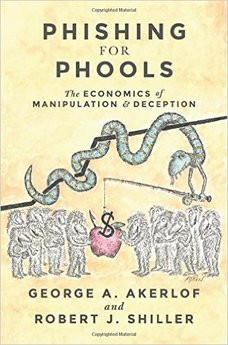
In their latest popular book ‘Phishing for Phools: The Economics of Manipulation and Deception’, George Akerlof and Robert Shiller provide an analysis of the economics of fraud. Akerlof’s lecture at Duke University provides an overview of the theory and Shiller’s TEDxYale talk introduces the idea further. Both are worth watching.  If you're stuck for time, Cass Sunstein offers a good review of the book which he titles Why Free Markets Make Fools of Us.

In short, Akerlof and Shiller claim that the free market acts as a double-edged sword. Despite the benefits, companies can take advantage of consumers and investors by using subtle forms of deception.  ‘Phishing’ connotes big companies suckering customers (the ‘phools’) into buying or investing in dubious products. They argue that phools can be informational victims where facts are distorted or framed a certain way to hook us in. Equally, our emotions can cause us to make bad decisions – emotional arousal may result in a purchase that is not in our long term interest. Examples include the sale of questionable financial investments, cigarettes, and shoddy housing to name but a few.   

Over the weekend I couldn’t help but think that gambling firms could take pride of place on this list of ‘phishermen’ after I viewed the array of betting products offered by the big gambling firms for football matches. While outright betting on football matches could be deemed fair, many big gambling firms clearly advertise what I would call ‘lemon bets’. These most often involve the consumer having to correctly predict multiple outcomes occurring.  For instance, ‘scorecast betting’ involves estimating which player will be the first goal scorer of a match and what the correct score will be – an extremely challenging task. Importantly, these bets are frequently advertised as ‘specials’ in the front window of bookmaker shops in Ireland and the UK despite the extremely low probability of them occurring. Bookmakers also allow customers to make their own product online, where they can combine any goal scorer with a range of score outcomes. The price offered usually appears to be attractive although statistically the predicted outcome is highly unlikely to occur. The conjunction fallacy comes to mind.

The portfolio of bets on offer by all big gambling firms is complex and exhaustive. Scorecasts are just one such example where, in my view, consumers can be ‘phished for a phool’. In Akerlof and Shiller’s scheme it will be likely that all big gambling companies will be forced to advertise these lemon bets to compete. A bad equilibrium will be the outcome.

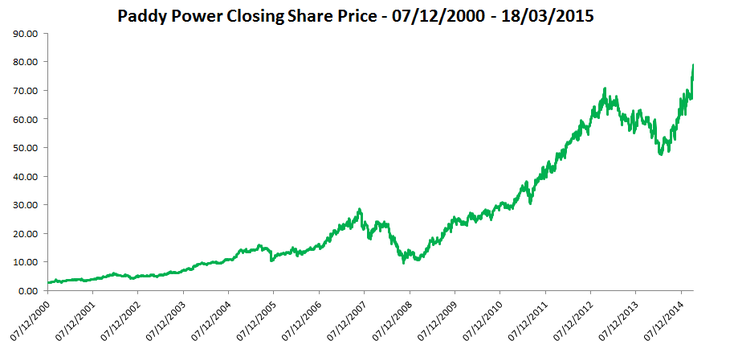
In Ireland there is a noticeable increase in advertising by gambling firms and their presence on social media has grown dramatically. My opinion would be that the growth of gambling has been aided by the dawn of smart technologies where the computer in our pockets allows us access to 24/7 gambling. The increasing market value of several gambling companies (see the Paddy Power closing share price below 2000-2015) most likely reflects a shift in demand for the product. 

The question is whether informational campaigns are required to protect consumers further? Informational campaigns are provided for other addictive products such as alcohol and cigarettes in an attempt to prevent some form of behavioural market failure. And while our emotions and lack of information do not necessarily lead to a bad decision in terms of gambling perhaps customers need to be reminded that (i) the incentives that are at play - gambling companies are profit-making enterprises and (ii) the information asymmetry -  crucially,  the gambling firms have more information then me or you; they are statistical experts.

Picture

Born Supremacy

4/3/2016

 
PictureBirth data for EU28 courtesy of Eurostat. Footballer data courtesy of Opta and Opta Pro
By Ed Valentine

Jenson Button, Lewis Hamilton and Michael Schumacher. Toni Kroos, Victor Valdes and David Silva. All are world champions in their respective sports. All were born in January.  While this might seem like a coincidence, a growing body of work into this area known as relative age effects now suggest when you are born actually matters!

Assuming a January 1st cut-off date, a person born in the earlier will generally have a physical advantage over somebody born later in the year. Take January and November for example. This ten month difference in birth dates at Under-12 level represents about 8% of the players total life time – a significant amount of time. Footballers generally, though anecdotally, reach their peak between the year 25 and 29. At this stage a 10 month difference counts for about 3% of total life time. Once players begin a professional career the difference in physicality and performance may be long eroded but the key point is the beginning of the career.

Data has been analysed across 30 different elite leagues around the globe and unsurprisingly the numbers favour players born in the first half of the year. There is one notable exception to this however – England. This is because the cut off for birthdays in junior level is taken in September rather than January. The average birth date of elite players in their respective leagues are all in the first six months of the year. In England it’s in the second half of the year.

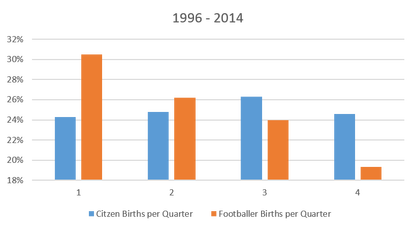
Across Europe the average birthdate of a citizen is the 1st of July – more or less in the middle of the year. The average birthdate for a professional footballer across 31 of Europe's top leagues is the 9th of May. The data table demonstrates a relatively even spread of birthdates for Europe’s citizens. There are more than 10 percentage point’s difference between the numbers of professional footballers born in the first quarter of the year versus the last quarter with the trend throughout the year being downward.

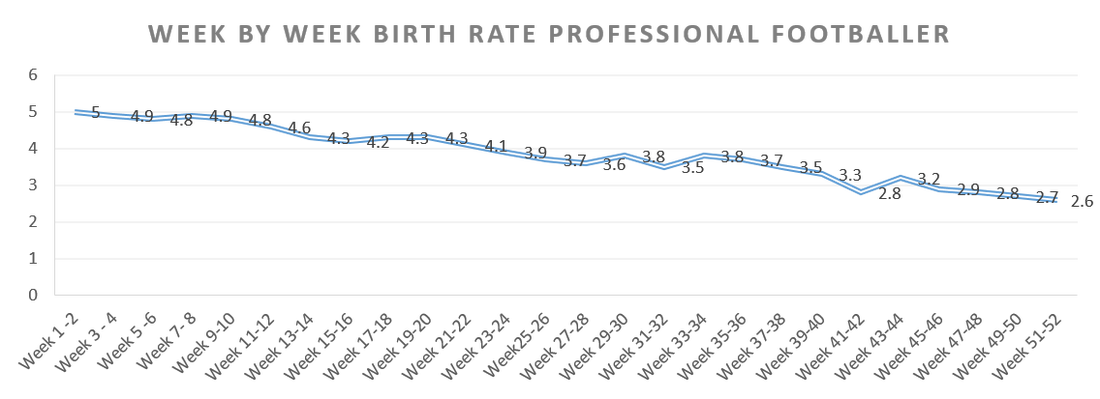
The data collected further demonstrates there is a significant favourable variance weighted towards the first 6 months of the year. Those born in the final 16 weeks of the 52 are significantly under represented as the graph below shows. Again, this data covers players competing in topflight leagues from Austria, Belarus, Belgium, Bulgaria, Croatia, Cyprus, Czech Rep., Denmark, *England, Finland, France, Germany, Greece, Hungary, Israel, Italy, Norway, Poland, Portugal, Romania, Russia, Scotland, Serbia, Slovakia, Slovenia, Spain, Sweden, Switzerland, The Netherlands, Turkey and Ukraine
Picture
Source: Opta and Opta Pro *Data for England covers both the EPL and Championship

Keeping Tabs on the Experts

2/3/2016

 
By David Butler

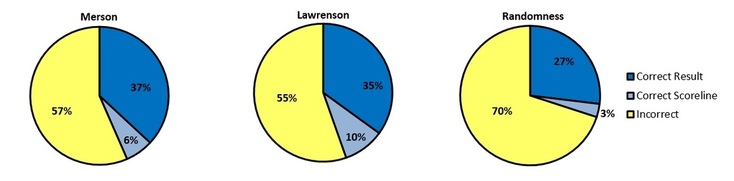
This website has a 'Follow the Pundit!' section where I keep tabs on two football experts who make systematic predictions for the English Premier League. After 260 predictions as of last weekend, the stats for Paul Merson and Mark Lawrenson make for pretty grim reading.  In short, they get more wrong then right and fall for some classic psychological biases.

Is this something unique to these pundits or to the Premier league? Probably not.  This year Ian Holloway, an English football manager and former player has been recruited by Sky Sports have to predict the score line of Football League Matches – this gives us a chance to look at the predictive success of an expert outside of the elite English division.  Ollie however gets on just as poorly as Merse and Lawro. On my count he has predicted 303 Football League (Championship, League 1 & League 2) matches this season. Just like our two Premier League pundits he calls one in ten correct scorelines, but usually gets more results wrong than right in the average week too.  

It’s critical for the sport that the expert’s predictions are imperfect, but keep the information above in mind the next time you hear a pundit predict a football result. How accurate are the experts? About as accurate as you or me!  
Picture
Forward>>

    Archives

    December 2025
    November 2025
    October 2025
    September 2025
    August 2025
    July 2025
    June 2025
    May 2025
    April 2025
    March 2025
    February 2025
    January 2025
    December 2024
    November 2024
    October 2024
    September 2024
    August 2024
    July 2024
    June 2024
    May 2024
    April 2024
    March 2024
    February 2024
    January 2024
    December 2023
    November 2023
    October 2023
    September 2023
    August 2023
    July 2023
    June 2023
    May 2023
    April 2023
    March 2023
    February 2023
    January 2023
    December 2022
    November 2022
    October 2022
    September 2022
    August 2022
    July 2022
    June 2022
    May 2022
    April 2022
    March 2022
    February 2022
    January 2022
    December 2021
    November 2021
    October 2021
    September 2021
    August 2021
    July 2021
    June 2021
    May 2021
    April 2021
    March 2021
    February 2021
    January 2021
    December 2020
    November 2020
    October 2020
    September 2020
    August 2020
    July 2020
    June 2020
    May 2020
    April 2020
    March 2020
    February 2020
    January 2020
    December 2019
    November 2019
    October 2019
    September 2019
    August 2019
    June 2019
    May 2019
    April 2019
    March 2019
    February 2019
    January 2019
    December 2018
    November 2018
    October 2018
    September 2018
    August 2018
    July 2018
    June 2018
    May 2018
    April 2018
    March 2018
    February 2018
    January 2018
    December 2017
    November 2017
    October 2017
    September 2017
    August 2017
    July 2017
    June 2017
    May 2017
    April 2017
    March 2017
    February 2017
    January 2017
    December 2016
    November 2016
    October 2016
    September 2016
    August 2016
    July 2016
    June 2016
    May 2016
    April 2016
    March 2016
    February 2016
    January 2016
    December 2015
    November 2015
    October 2015
    September 2015
    August 2015
    July 2015
    June 2015
    May 2015
    April 2015
    March 2015
    February 2015
    January 2015
    December 2014
    November 2014
    October 2014
    September 2014
    August 2014
    July 2014
    June 2014
    May 2014
    April 2014
    March 2014
    February 2014
    January 2014
    December 2013
    November 2013
    October 2013
    September 2013
    August 2013
    July 2013

    About

    This website was founded in July 2013.

    RSS Feed

    Categories

    All
    American Football
    Athletics
    Baseball
    Basketball
    Behavioural Economics
    Boxing
    Broadcasting
    Competitive Balance
    Cricket
    Cycling
    Darts
    David Butler
    Declan Jordan
    Drugs
    Ed Valentine
    Epl
    Esports
    Expenditure
    F1
    Fifa World Cup
    Finances
    Funding
    Gaa
    Gaelic Games
    Gambling
    Game Theory
    Gary Burns
    Geography
    Golf
    Greyhound Racing
    Guest Posts
    Horse Racing
    Impact Studies
    John Considine
    John Eakins
    League Of Ireland
    Location
    Media
    Mls
    Mma
    Olympics
    Participation
    Paul O'Sullivan
    Premier League
    Regulation
    Research
    Robbie Butler
    Rugby
    Simpsonomics
    Snooker
    Soccer
    Spatial Analysis
    Sporting Bodies
    Stephen Brosnan
    Swimming
    Taxation
    Teaching
    Technology
    Tennis
    Transfers
    Uefa
    Ufc
    World Cup
    Wwe

Powered by Create your own unique website with customizable templates.