The Economics of Sport
  • Sports Economics
  • About
  • Workshop
  • Selected Publications
  • Book Reviews
  • A Primer on Gaelic Games
  • Upcoming Events
  • Media
  • Education
  • Resources & Links

BT Sport & Irrational Behaviour

17/2/2014

 
By Robbie Butler

For the 12th time this season, I left home yesterday in search of a pub showing the live FA Cup game between Arsenal and Liverpool. In recent years, I had become somewhat spoiled. Thanks to a subscription to Sky Sports and ‘free’ access to ESPN, every Premier League and FA Cup game was available at home at the touch of a button.

I never thought I say this, but god how I miss ESPN. Kevin Keegan, Ray Stubbs, Rebecca Low, even John Barnes! That red studio setting. 5.30pm Saturday evening…the memories.

Enter BT Sport to break up this paradise.

Since the arrival of the telecom giant I have been forced to search Cork city for pubs with access to this channel. It reminds me of the early days of Sky, when literally only your ‘TV mad’ neighbours up the road, had the channel. The crazy thing about this is how irrational my behaviour appears to be.   

I refused to get BT in the summer on the grounds of cost (and principle). The cost argument doesn’t stack up. The Setanta Sports Pack (where BT Sport can be found) costs €19.99 per month. That’s a cost of roughly €120 had I ordered the channel at the start of the season or €10 approx. per game. I have spent far more on food, drink, petrol, parking, etc. over the course of my twelve ‘pub’ games since August, not to mention the time it’s taken. Completely irrational behaviour it would seem. 

So why don’t I subscribe? I don’t know really. Cost can’t be the issue. Maybe it’s principle. However, Sky Sports will tell you they don’t last very long. Maybe it’s the excuse to get out of the house and watch live football surrounded by others. Nothing better! Or maybe it’s just inertia and that I simply haven’t got around to making the call to Setanta yet.  

Whatever the answer, I appear to be contradicting one of the key principles of the field we study….people are rational! That principle might require revision. 
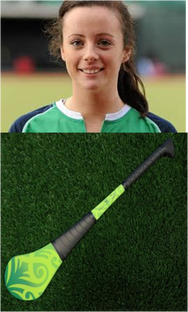
Where Offaly Leads the Hurling World

15/2/2014

0 Comments

 
By John Considine
In the last 24 hours a minor controversy has surrounded Offaly hurling.  The controversy was sparked by former Clare player and manager Ger Loughnane.  The Clare man pointed out how Offaly players were carrying a bit of excess weight.  Loughnane writes for the printed media, and is a TV panellist, on hurling matters.  Two former Offaly players, who are also prominent media personalities, responded.  Michael Duignan and Daithi Regan took Loughnane to task for his views on Offaly players and hurling (see HoganStand piece here).  While Offaly hurling may be struggling on the field, it is leading the hurling world off the field when it comes to some technological developments.
Picture
It was in Ferbane, County Offaly, that two hurling entrepreneurs made one of the most successful changes in the design and manufacture of hurling sticks.  Tom Wright and John Grehan brought the carbon fibre stick to the market under the name Cultec (the "cul" referring to the Irish word for goal and the "tec" referring to the technology).  In 2008 they sold approximately 800.  Since then they have gone from strength to strength.  In 2013 they sold over 20,000 sticks to those playing the game.  (The Cultec website can be accessed here.)

I met these two individuals in Tom's house in the summer of 2009.  I accompanied a graduate student who was interviewing Tom and John for her masters dissertation.  The graduate student was Aine Connery.  Aine played both hockey and camogie at the highest levels.  She was a key member of the Irish international hockey team that narrowly failed to qualify for the 2012 London Olympics.  She was also prominent in Kilkenny camogie circles.  Aine was aware of how the hockey stick had evolved from timber (mulberry) to graphite.  She was interested in the implications for camogie/hurling of the carbon fibre stick starting to gain market share.  As a result, we found ourselves in Ferbane.  (Given the wonderful scones provided in the Wright household one could understand why Offaly hurlers might carry a few extra pounds.  That said there is a problem with this line of reasoning as Tom is a Tipperary native.)

Tom and John explained to Aine how they had gone through a long, slow process to develop their product.  It was a labour of love.  The genesis of the idea arose out of the shortage of ash for timber sticks during the 1970s and 1980s.  A plastic piping company, Wavin, had developed a plastic stick.  The Wavin product failed to gain market share due to the vibrations it transmitted to the hurler's hands.  It was also deemed potentially dangerous because it did not break easily, and when it did break, it did not do so in a predictable way.  The importance of a breaking point in their product was something that Tom and John found was crucial in their efforts to persuade the GAA to give the Cultec stick its blessing.

There was only one rule in the GAA rulebook that the Cultec product had to satisfy.  The rule specified a limit on the size of the strike zone (the bas).  At its widest point it was only to be 13cms.  The initial prototype developed by Tom and John satisfied this rule.  The problem was that players were not happy with this small bas.  It was only then that Tom and John discovered that the rule was rarely observed or enforced.  Most adult players have a stick that has a strike zone that exceeds the limit.  There was little interest in a product with a small strike zone.  It was back to the drawing board.

The product was being tested in Athlone Institute of Technology.  The tests suggested the Cultec product had a larger sweet spot for striking and that it possibly hit the ball further than the timber stick.  The tests also revealed a product that was more durable than the timber competitor.  This durability partly explains why the Cultec stick selling price is slightly higher than the timber stick.

In an effort to break into the market for younger players, the Cultec stick came in a variety of colours.  Pink was a popular colour  with camogie players.  In recent years they have tended to focus on the timber coloured sticks.  To date, much of Cultec's success is based on the uptake in their product amongst younger players.  It is only beginning to have an impact at the higher levels of the game.  This weekend the Allianz National Hurling League starts.  The poster boy for Cultec is Dublin hurler Ryan O'Dwyer.  Cultec feel confident that the number of high profile players using the stick will increase.as those who have used it as a kids get older.

The carbon fibre stick is here to stay.  It has captured enough of the market to make Cultec a viable commercial venture.  While it is too early to say what impact the Ash Dieback disease will have on the availability of timber, it must be reassuring to the GAA to know there is a viable alternative.  Cultec will be around long after the debate about the size of the bellies, legs and arses of the Offaly hurlers has subsided.

0 Comments

Evidence for the 'Hot-Hand'?

14/2/2014

 
By David Butler

The hot-hand 'fallacy' is a mistaken belief that if an individual successfully achieves an objective randomly, this causes a greater chance of additional success in the given activity for the short term future. The phenomenon has been studied in greatest detail through the lens of sport, in particular basketball, and is often cited by behavioural economists as an example of how individuals make cognitive ‘errors’, making up stories to explain apparent patterns or rationalising what has gone before them in a narrative.

Originally applied to a sporting context by Thomas Gilovich and Amos Tversky in the mid 1980's, the majority of the literature on the issue suggests that sports stars going through ‘hot’ or ‘cold’ streaks, in terms of performance, is an illusion (contrary to what fans and coaches so often think!). Simply put, basketball players are not more likely to make their next shot given that they have made their previous two or three shots in a row.

However a recent study that accesses panel data from Major League Baseball finds evidence to support the existence of the 'hot-hand'. The author’s claim to overcome several problems not given due attention by previous studies such as controlling for strategic interactions within a tie and conclude that the (10!) statistical tests conducted by them actually all show evidence in favour of the hot-hand.

The authors attribute the presence of this to differences between baseball and basketball suggesting that basketball presents “sufficient opportunity for defensive responses to equate shooting probabilities across players whereas baseball does not. As such, much prior evidence on the absence of a hot hand despite widespread belief in its
presence should not be interpreted as a cognitive mistake as it typically is in the literature, but rather, as an efficient equilibrium adjustment.”

From my reading of things, the authors are simply pointing out that in basketball 'hot' players can be targeted more intensively by defensives but such luxuries don't exist in baseball.

2014 Grand National Weights

13/2/2014

 
By Robbie Butler

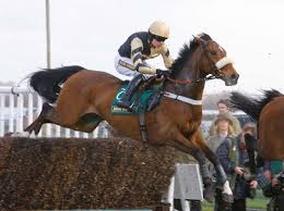
The weights for the 2014 Crabbies Grand National were announced this week by the BHA’s Senior Handicapper Phil Smith. Unlike all other national hunt races run in Great Britain, the Grand National is the only race in the calendar where the handicapper is in a position to exercise discretion when allocating the weights. The unique challenges posed by Aintree are taken into account and Smith is allowed to given ‘course and distance’ specialists extra weight where it is deemed necessary.

The highest horse in the handicap announced this week is veteran Tidal Bay. The Paul Nicolas trainer teenager is enjoying an Indian summer in his career and will carry 11st 10lbs if he runs on April 5th. While it may seem unfair for a thirteen year old to carry top weight, had Smith applied the official BHA rating, Tidal Bay would be carrying even more weight in relative terms, conceding 3lb extra to Long Run and 4lb extra to Hunt Ball.

On this Smith said “Framing the handicap had its moments. A week after I started, I tore up what I had done and started again. Tidal Bay’s run last Sunday really helped. I had him performing to a mark of 161, which is below his best, but I have put him on that mark for the National. He was actually rated 1lb higher last year.” Tidal Bay may in fact be ‘well in’.
PictureTidal Bay in action during the Welsh Grand National
So what do the stats suggest? Over the past 30 year the mean age of the winning horse has been 10.07 years, with a median of 10 and standard deviation of 1.11.

Thirteen year old Tidal Bay appears too old. In fact, only two thirteen year old horses have ever won the race; once in 1894 and again in 1923. Amazingly, Peter Simple won the race in 1853 at the grand old age of fifteen!

As far the weights are concerned, since 1984 the average winning weight has been 10st 7.73lbs, with a median weight of 10st 6.5lbs and a stand deviation of 5.64lbs. Tidal Bay’s 11st 10lbs would again appear to be too much, however, four of the last five winners have all carried 11st or more.

State Examinations and Student Participation in Sport

12/2/2014

0 Comments

 
By John Considine
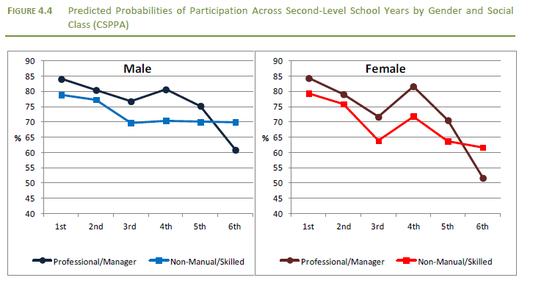
Chapter 4 of Keeping Them in the Game is devoted to examining what happens to sporting participation amongst Irish students as they make their way through second-level education.  In a previous post (here) I examined how Keeping Them in the Game presented the relationship between Leaving Certificate results and the type of sport that students participate in.  There is a most interesting relationship between the Leaving Certificate and sporting participation presented in the same chapter.

Figure 4.4 from Keeping Them in the Game is reproduced below.  It presents the relationship between social class and sports participation from first year to sixth year.  The data is presented for males and females.  The figure shows that for the first five years of education, sporting participation is higher amongst children from the professional/manager class than for children from the non-manual/skilled class.  This situation is dramatically reversed in Leaving Certificate year.  In sixth-year there is a huge fall-off in participation by children from the professional/managerial class.  The drop in male participation is from 75% to 60%.  The drop in female participation rates is from 70% to 50%.

Figure 4.4. presents the data on one of a range of issues examined in chapter 4.  In addition to examining the relationship between social class and sports participation, it addresses issues dealing with (i) sporting participation amongst early school leavers, (ii) transition year participation rates, (iii) possible 'relative age' effects, and (iv) the relationship between other school activities and sporting participation.  The chapter should be read by everyone involved in education and sport for this age group.
Picture
0 Comments

Shirt Sponsors - 1993 & 2013

11/2/2014

 
Picture
By Robbie Butler

Prior to the sacking of Michael Laudrup last week, the Premier League boasted no less than ten non-British managers. This is a long way from the early days of the Premier League, when foreign managers were as infrequent as clean sheets have become at Old Trafford. In fact since 1992 the Premier League has become a vastly more diversified place. Managers, players and spectators are now drawn from all four corners of the globe. While this took some time to catch on, the corporate world was ahead of the curve. 

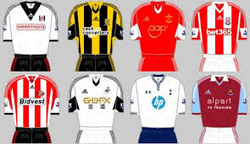
Spectators at all ten grounds hosting matches over the next two nights will be bombarded will all sorts of advertisement and marketing ploys. The most obvious of these are the sponsors paraded by players and fans sporting club gear. 

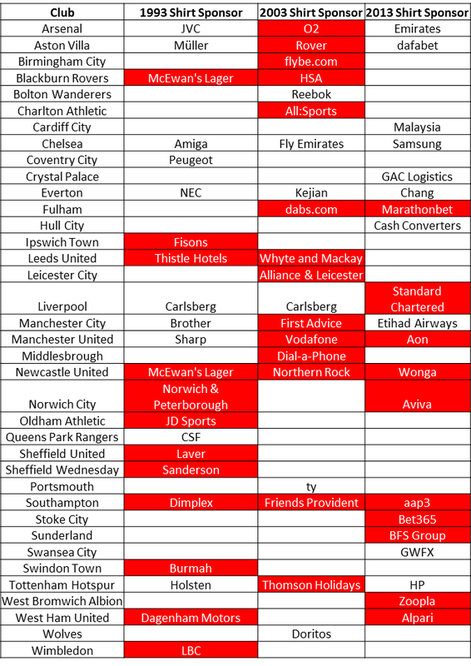
The 1993-1994 season kicked-off with no less than ten non-British shirt sponsors. Twenty years later the 2013-2014 season kicked-off with the same number of non-British short sponsors - ten. Given that the 1993-1994 season has 22 teams in the top division, this season is slightly more in percentage terms.

The table below presents data on this with British sponsors marked in red. Amazingly, despite the internationalisation of the league, the number of non-British sponsors in the 2003-2004 season was just six. Maybe the forward looking international sponsors are the cause of the internationalisation of the Premier League not an effect of its internationalisation. Finally, can you spot the only ever ‘Irish’ shirt sponsor of a Premier League Team?

Picture

Anti-Doping Test Figures

10/2/2014

0 Comments

 
By John Considine
Picture
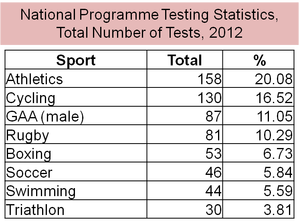
The Irish Sports Council (ISC) annual report provides a range of details on the Anti-Doping tests they conduct.  This post examines the National Programme Testing Statistics for 2012.  The table opposite lists the sports that had at least 30 tests conducted.  The sports are presented in order of the number of tests conducted.  Athletics had the largest number of tests conducted (158) and the sport accounted for over 20% of all of the tests on the National Programme.  Athletics, Cycling, GAA and Rugby between them account for over half of all the test conducted.  The figure for GAA is for the male games in hurling and football.  It excludes the 4 tests on camogie players and 2 tests on players from Ladies Gaelic Football.

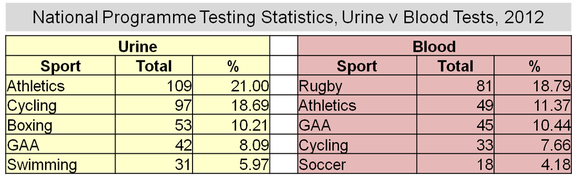
The ISC decompose the figures between Urine test and Blood tests. The table below lists the top sports for each type of test.  Three sports make the top-5 for both urine tests and blood tests.  These sports are Athletics, Cycling and GAA.  The other sports to make the top-5 Urine tests are Swimming and Boxing. In terms of blood tests, Rugby and Soccer are in the top-5.  Rugby tops the list for blood tests as all its National Programme tests are blood tests (no urine tests).

Picture
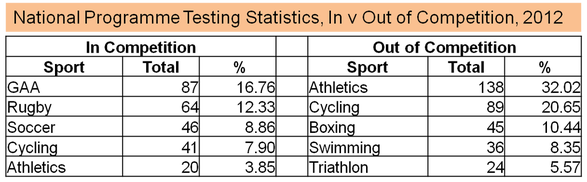
The ISC decompose the figures between tests that are conducted In-Competition and those that are conducted Out-of-Competition.  The table below lists the top sports for each type of test.  The team field sports of GAA, Rugby and Soccer top the list for In-Competition tests.  All of the GAA and Soccer tests are conducted In-Competition.  The Out-of-Competition sports might be classified as individual sports (accepting that these athletes frequently are part of an Irish team).  Athletics and Cycling account for over half of all Out-of-Competition testing between them.  
Picture
0 Comments

The Fed Banks On Racquet To Win In Court

8/2/2014

 
PictureSource: IBM Tournament Stats at ausopen.com
By Ed Valentine

In Formula 1 and many other sports the equipment can often be what differentiates performance between competitors. It could be said that this is also true for tennis and golf, but one could argue performance differentiation is more down to the skill of the athletes rather than the level of technology that has gone into the racquet or club. A comment by Roger Federer during January’s Australian Open got me thinking to what degree in tennis could the equipment give a competitor an advantage?
 
The 17 time Grand Slam winner has switched from a 90sq inch to a 98sq inch racquet head. In theory this should allow a player to increase control (due to the larger sweet spot) and importantly transfer more speed from the racquet into the ball thus giving rise to the chance of dominating from the back of the court.

When asked about the need to change Federer commented “I’m hitting the ball really well, so I’m very pleased with the racquet. It allows me to generate more speed from the base line”.

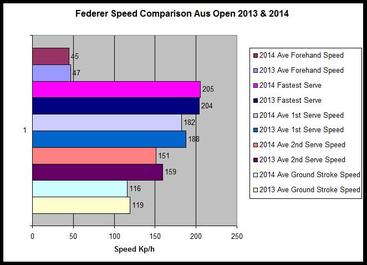
Looking at the data generally the world no. 8 is actually hitting the ball slower than he was at the Australian Open last year. Other than his marginally quicker 1st serve his main shot selections are generating a slower transfer of speed from the racquet into the tennis ball.
 
Although the average dip in ball speed is 3.6kp/h this isn’t enough to be a cause for concern. What is striking, however, is his perceived increase in speed. Though the frame is different the string tension is roughly the same at 21.5kg on the mains and 20kg on the cross strings which is just as it was on his previous racquet. It seems that the equipment in this case gives a psychological rather than a technical advantage. Federer won 79.9% of his first serves and 124 1stserve return points* down under which in percentage terms put him firmly back in the top 4 players in the tournament. 

Smiles in Sochi

6/2/2014

 
By David Butler

Thinking about the upcoming Winter Olympics reminded me of a classic paper by Medvec, Gilovich & Madey in 1995 - When Less Is More: Counterfactual Thinking and Satisfaction among Olympic Medallists in the Journal of Personality and Social Psychology.

The authors explored how counterfactual thoughts impacted emotions by analysing the reaction of bronze and silver medallists in the 1992 Olympic Games at the end of specific events and when athletes mounted the podium.

The essence of their theory was that, in terms of happiness, finishing 3rd and receiving a bronze was a better outcome than finishing 2nd. The authors concluded that winning the bronze gives greater happiness than winning the silver as those that win silver think about the counterfactual alternative: what if I had won the gold? In contrast to this, the bronze winner compares themself to the rest of the field that didn't get near the podium. 

As Medvec and Savitsky explained in a paper two years later, receiving a bronze elicits a downward counterfactual comparison, while receiving silver elicits an upward one. In this regard we may not weigh up our achievements objectively and rather compare what we have achieved to 'what could have been'.

In 2005 McGraw, Mellers & Tetlock carried out three studies of the 2000 Summer Olympics in Australia. The authors suggested that Olympic athletes are more likely to make counterfactual comparisons based on their prior expectations (the idea that silver medallists having higher expectations had been ruled out in the first study) and found that surprising outcomes produce stronger emotional reactions.

Perhaps finishing second in sports competitions can really be a mixed blessing but as Medvec, Gilovich & Madey ask near the end of the paper; does the immediate happiness effect only last over a short run period and are we likely to look back more fondly on second place in years to come?

The CIES Football Observatory Report

5/2/2014

 
By Robbie Butler

The 6th edition of the annual CIES Demographic Study on football was recently published. The report examines the "31 top division leagues of UEFA member associations", covering more than 470 clubs and over 11,500 players. 

The report offers some stern words for those involved with football clubs which could be deemed as worrying for the future. Depsite the current economic conditions in Europe the CIES suggest:

"The cloud of economic stakes that hangs over sporting logics is flagrant in many clubs and countries. In general, the number of transfers carried out by teams during the current season is at an all-time high. A trend that is difficult to understand given the actual climate with its numerous financial difficulties".

Some of the main findings in the report (which can be viewed here) are as follows:
   1. The relative presence of footballers playing for the club where they were trained reached a new record low.
   2. The English Premier League has the second highest percentage of expatriate footballers.
   3. Transfer activity is much higher in Southern and Eastern Europe than in the northern part of the continent.
   4. The tallest league is German Bundesliga (183.8cm), while the shortest is Spanish Liga (180.1cm). 
   5. Barcelona have the second shortest squad (177.4cm) among the 472 clubs surveyed!!
   6. Finally, Ajax top the table of clubs having trained the most players under contract with top division teams.
<<Previous
Forward>>

    Archives

    May 2026
    April 2026
    March 2026
    February 2026
    January 2026
    December 2025
    November 2025
    October 2025
    September 2025
    August 2025
    July 2025
    June 2025
    May 2025
    April 2025
    March 2025
    February 2025
    January 2025
    December 2024
    November 2024
    October 2024
    September 2024
    August 2024
    July 2024
    June 2024
    May 2024
    April 2024
    March 2024
    February 2024
    January 2024
    December 2023
    November 2023
    October 2023
    September 2023
    August 2023
    July 2023
    June 2023
    May 2023
    April 2023
    March 2023
    February 2023
    January 2023
    December 2022
    November 2022
    October 2022
    September 2022
    August 2022
    July 2022
    June 2022
    May 2022
    April 2022
    March 2022
    February 2022
    January 2022
    December 2021
    November 2021
    October 2021
    September 2021
    August 2021
    July 2021
    June 2021
    May 2021
    April 2021
    March 2021
    February 2021
    January 2021
    December 2020
    November 2020
    October 2020
    September 2020
    August 2020
    July 2020
    June 2020
    May 2020
    April 2020
    March 2020
    February 2020
    January 2020
    December 2019
    November 2019
    October 2019
    September 2019
    August 2019
    June 2019
    May 2019
    April 2019
    March 2019
    February 2019
    January 2019
    December 2018
    November 2018
    October 2018
    September 2018
    August 2018
    July 2018
    June 2018
    May 2018
    April 2018
    March 2018
    February 2018
    January 2018
    December 2017
    November 2017
    October 2017
    September 2017
    August 2017
    July 2017
    June 2017
    May 2017
    April 2017
    March 2017
    February 2017
    January 2017
    December 2016
    November 2016
    October 2016
    September 2016
    August 2016
    July 2016
    June 2016
    May 2016
    April 2016
    March 2016
    February 2016
    January 2016
    December 2015
    November 2015
    October 2015
    September 2015
    August 2015
    July 2015
    June 2015
    May 2015
    April 2015
    March 2015
    February 2015
    January 2015
    December 2014
    November 2014
    October 2014
    September 2014
    August 2014
    July 2014
    June 2014
    May 2014
    April 2014
    March 2014
    February 2014
    January 2014
    December 2013
    November 2013
    October 2013
    September 2013
    August 2013
    July 2013

    About

    This website was founded in July 2013.

    RSS Feed

    Categories

    All
    American Football
    Athletics
    Baseball
    Basketball
    Behavioural Economics
    Boxing
    Broadcasting
    Competitive Balance
    Cricket
    Cycling
    Darts
    David Butler
    Declan Jordan
    Drugs
    Ed Valentine
    Epl
    Esports
    Expenditure
    F1
    Fifa World Cup
    Finances
    Funding
    Gaa
    Gaelic Games
    Gambling
    Game Theory
    Gary Burns
    Geography
    Golf
    Greyhound Racing
    Guest Posts
    Horse Racing
    Impact Studies
    John Considine
    John Eakins
    League Of Ireland
    Location
    Media
    Mls
    Mma
    Olympics
    Participation
    Paul O'Sullivan
    Premier League
    Regulation
    Research
    Robbie Butler
    Rugby
    Simpsonomics
    Snooker
    Soccer
    Spatial Analysis
    Sporting Bodies
    Stephen Brosnan
    Swimming
    Taxation
    Teaching
    Technology
    Tennis
    Transfers
    Uefa
    Ufc
    World Cup
    Wwe

Powered by Create your own unique website with customizable templates.